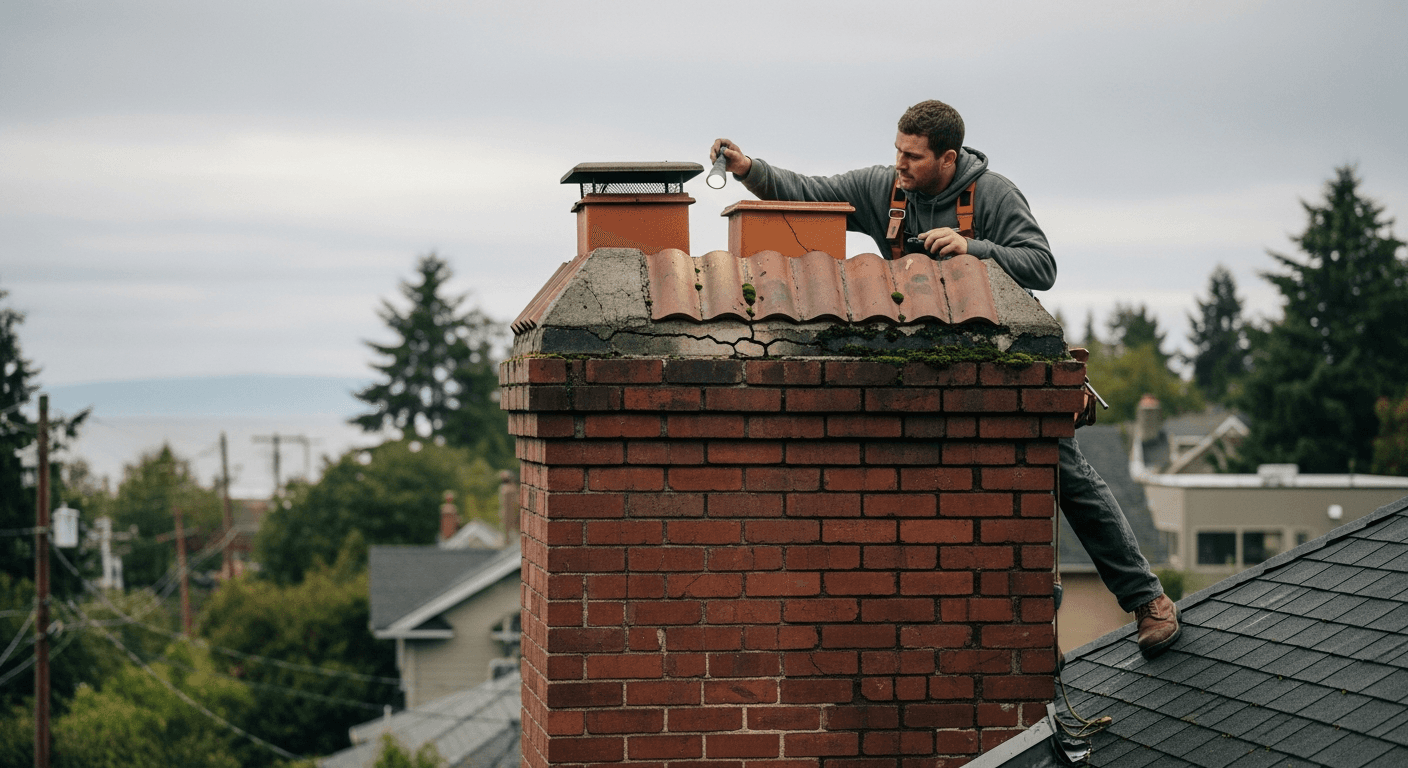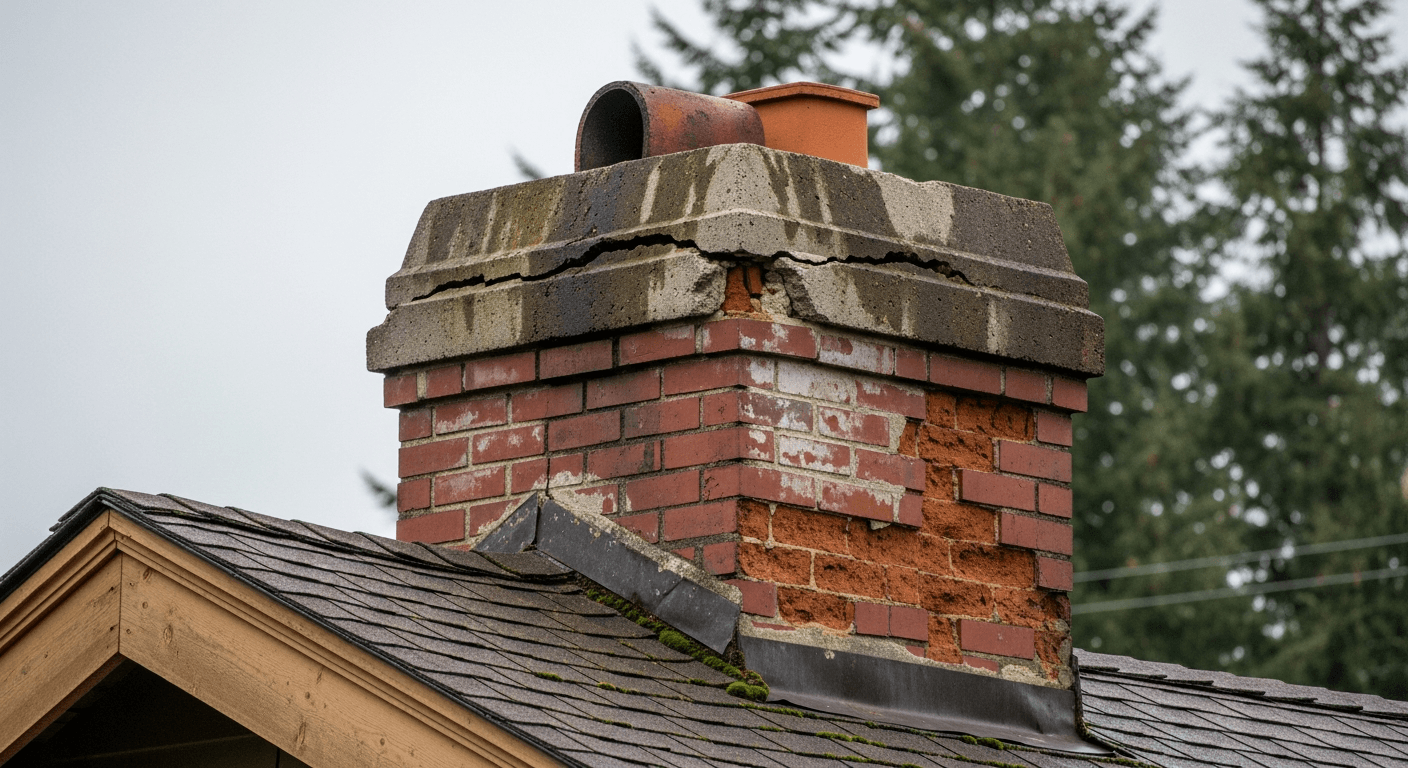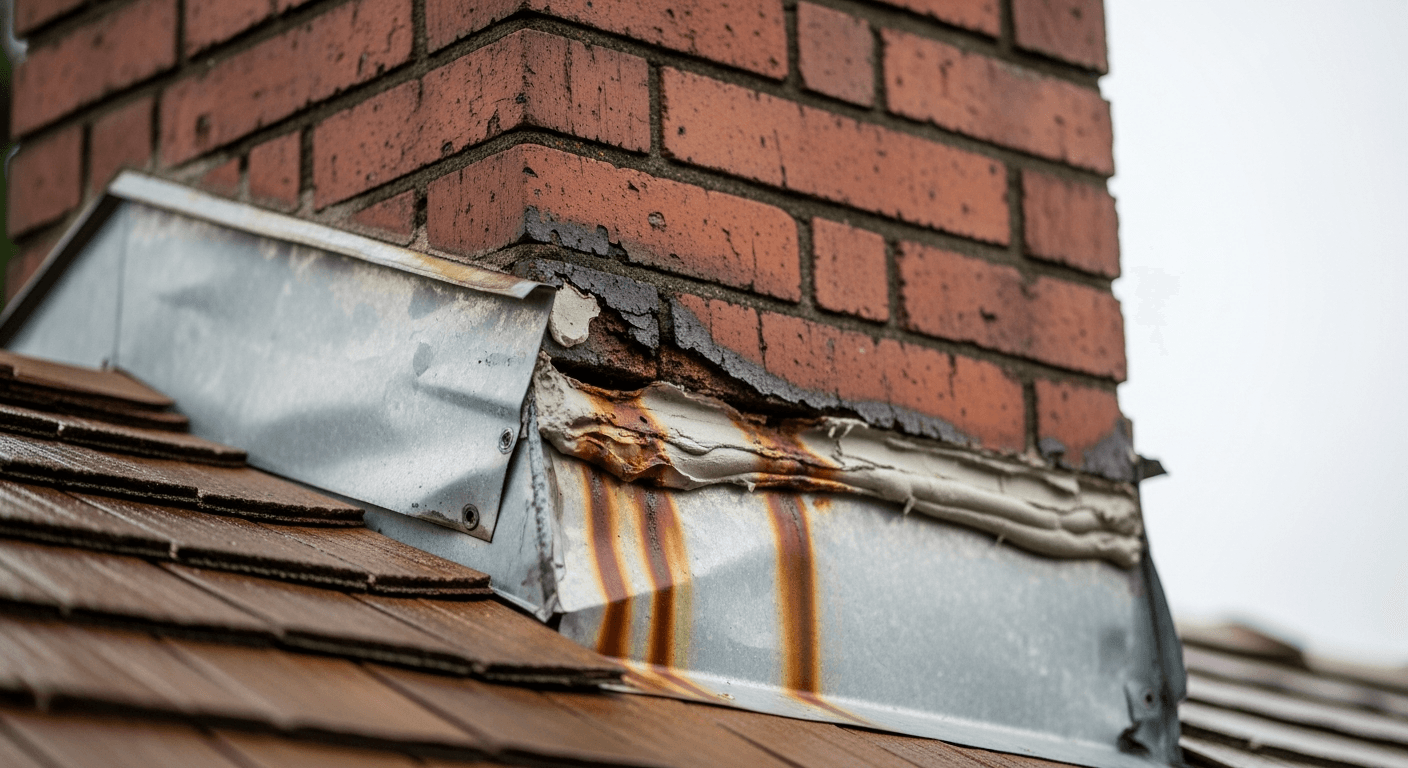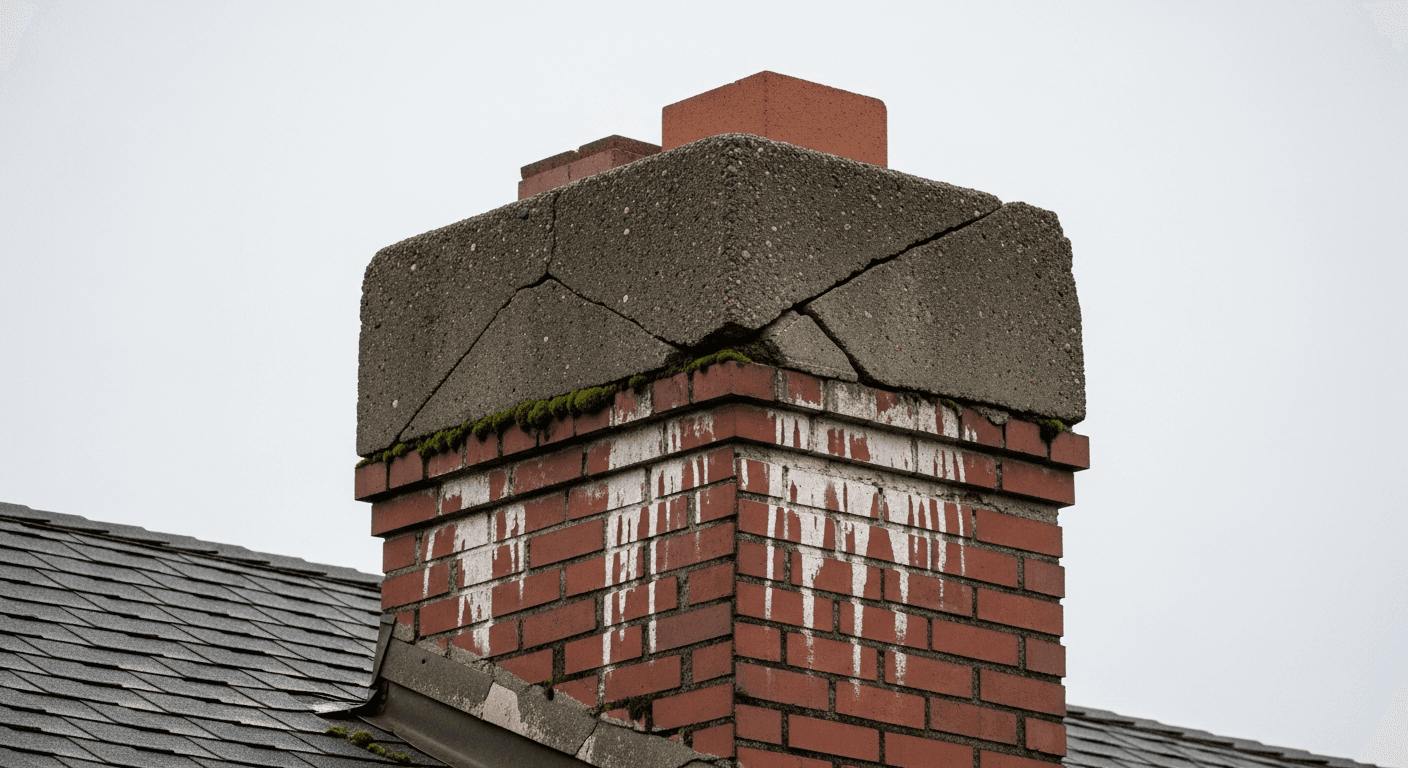
Yes — if your Tacoma chimney has visible cracks at the top, white mineral staining on the brick face, or water in the firebox after a rainstorm, it almost certainly needs crown repair, waterproofing, or both. A failed crown is the single most common entry point for water damage on Tacoma chimneys: moisture penetrates the crack, freezes during a cold snap, and mechanically splits mortar joints and brick from the inside out. Tacoma's average 38 inches of annual rainfall, combined with salt air off Commencement Bay, accelerates this process faster than most homeowners realize — particularly on the thin mortar-wash crowns found on pre-1950 Craftsman and bungalow homes throughout the North End, Proctor, and Hilltop neighborhoods.
What a chimney crown does — and why Tacoma's climate destroys them faster than average
The chimney crown is the concrete or mortar cap that seals the top of the chimney stack around the flue liner. A properly built crown slopes downward at least two inches from the flue collar to the outer edge, shedding rainwater away from the masonry rather than letting it pool and soak in. Without a sound crown, every Tacoma rainstorm delivers water directly into the gap between the flue liner and the outer brick, saturating mortar joints and migrating down into the firebox, attic framing, and interior ceilings.
The problem is especially severe on pre-1950 homes throughout Pierce County. Those chimneys were typically finished with a thin mortar wash — not a true formed-and-poured concrete crown — that was never engineered to last more than fifteen to twenty years. Most of those washes are now cracked through or missing sections entirely. Each freeze-thaw cycle Tacoma experiences between November and March wedges existing cracks incrementally wider.
Salt air from Commencement Bay and the Tacoma Narrows chemically erodes both mortar and bare concrete, particularly within a mile or two of the waterfront. Homeowners in North End, Old Town, Ruston, and Proctor regularly see crown deterioration five to ten years sooner than those in inland neighborhoods like South Tacoma or Parkland. If your home is in a waterfront zone, inspect the crown every three years rather than the standard five.
Crown repair vs. full crown replacement — the honest test for knowing which one you need
Not every damaged crown requires full replacement. A crown with hairline cracks that have not yet separated can be stabilized with a flexible elastomeric crown sealer — a product engineered specifically for masonry that bridges cracks up to about one-eighth of an inch and cures to a continuous waterproof membrane. Correctly applied and re-inspected every three to four years, this repair reliably lasts eight to fifteen years on Tacoma chimneys.
Full replacement is the only durable fix when the crown has gaps wider than an eighth of an inch, missing sections, a shifted or off-level surface caused by flue tile movement or brick settlement below, or when the mortar wash has softened and crumbles under hand pressure. A replacement crown should be poured from a low-water-ratio mix formulated to resist Pacific Northwest freeze-thaw cycles, sloped a minimum of two inches from flue collar to outer edge, and finished with a drip edge that clears the brick face entirely.
The field test: if a screwdriver blade slides into a crack without force, the crack is too wide for sealant. If chunks of the crown lift when you press on them, or if new water stains appear on your ceiling near the chimney after a hard rain, plan on replacement. Sealing over a structurally compromised crown hides the failure for one season while the damage beneath continues to grow.
What crown repair and chimney waterproofing cost in Tacoma — a realistic 2024–2025 breakdown
The figures below reflect what Tacoma homeowners are actually paying in 2024 and 2025. Costs vary based on chimney height, roof pitch, accessibility, and the extent of damage found during inspection. A single-story home in the South End with a low-slope roof costs meaningfully less to service than a two-and-a-half-story North End Craftsman where the chimney rises four feet above a steep roofline.
Waterproofing is almost always worth scheduling at the same visit as crown work. The crew is already on the roof; applying a penetrating silane-siloxane sealer to the exposed brick and mortar adds relatively little to the total cost but significantly extends the life of the crown repair by stopping moisture absorption into the masonry before it can restart the freeze-thaw cycle.
| Service | Typical Tacoma Cost (2024–2025) | Expected Service Life | Best Time to Schedule |
|---|---|---|---|
| Crown sealer / hairline crack repair | $150 – $350 | 8 – 15 years | Spring or early fall; requires 48 hrs dry weather |
| Full crown replacement (poured concrete) | $400 – $900 | 20 – 30+ years | Late spring through September |
| Chimney waterproofing (silane-siloxane masonry sealer) | $150 – $400 | 5 – 10 years | Spring or early fall; dry masonry required |
| Crown replacement + waterproofing combo | $500 – $1,100 | Varies by service mix | Same visit eliminates second mobilization cost |
| Upper-section mortar joint repointing | $200 – $600 | 10 – 20 years | Spring through early fall |
A real North End Tacoma scenario: the slow leak nobody caught for three winters
A homeowner on North 30th Street called us after noticing a persistent musty smell near the fireplace and a spreading brown water stain on the ceiling plaster in the upstairs bedroom directly above. The house was a 1924 Craftsman with the original clay-tile-lined masonry chimney — the most common configuration we encounter in that neighborhood.
On the roof, the crown was a textbook thin mortar wash job, cracked in four places with two corner sections broken away entirely. The brick below had absorbed enough moisture over three wet seasons that several mortar joints had softened to the consistency of dry sand and could be scraped out with a finger. Inside, the first three feet of clay tile liner showed heavy efflorescence — white mineral deposits left as evaporating water carried calcium out of the tile — indicating sustained moisture intrusion over multiple seasons.
The repair required a full crown replacement, repointing of the top eighteen inches of brick, and a penetrating waterproofing treatment over the entire above-roofline section. Total cost came to just under $900. The homeowner had already paid a roofer $200 to investigate the stain; the roofer found nothing because the chimney crown — not the roof flashing — was the water entry point. Catching the failure at the crown stage kept the total repair under $1,000. Another winter of the same moisture loading would likely have required clay tile liner replacement on top of everything else, pushing the bill to $3,000 or more.
How to check your Tacoma chimney crown from the ground — and when a professional look is non-negotiable
You do not need roof access for a useful preliminary inspection. From the ground with binoculars on a clear day, examine the flat cap surface at the top of the chimney stack. A sound crown is smooth and uniform in color. Cracks appear as dark lines running across the surface; spalling looks like raised edges or missing chunks. A rust-brown stain running down the brick face directly below the crown almost always means water is entering at the crown and carrying iron oxide out of the mortar as it travels down.
Inside, open the damper and look straight up with a flashlight. Visible daylight around the flue tiles, chunks of mortar or concrete debris on the firebox floor, or a gritty residue that does not look like soot are signs that pieces of the crown or liner have broken off. That condition warrants an immediate service call — operating a fireplace with a compromised flue liner creates a carbon monoxide and fire risk, not just a moisture problem.
The National Fire Protection Association standard NFPA 211 recommends a Level 1 inspection annually for any fireplace in regular use. For Tacoma homeowners, we recommend pairing that annual inspection with a dedicated crown and masonry check each spring, immediately after the heavy rain season ends in April or May. Any winter damage can then be repaired during the dry months of May through September — exactly the window needed before mortar and sealant products can cure properly.
Will homeowners insurance cover chimney crown repair or interior damage from a failed crown?
The short answer: almost never for the crown itself, and only sometimes for resulting interior damage. Washington State homeowners policies uniformly treat chimney crown deterioration as a maintenance failure rather than a sudden loss event. Because crown cracking develops gradually over multiple seasons — which adjusters can verify from inspection photos and records — claims are routinely denied under wear-and-tear and neglect exclusions.
Insurance may cover sudden interior water damage — soaked ceiling joists, damaged plaster, or ruined insulation — if you can document through a professional inspection report that the crown failure was not a known pre-existing condition and that the interior damage occurred abruptly rather than over time. Even then, approval is not guaranteed, and the chimney repair itself remains out-of-pocket. Read your policy exclusions carefully and speak with your agent before filing.
The practical approach: treat crown maintenance the same way you treat roof maintenance — as a recurring budget line, not an emergency fund item. A $200 sealant repair on a hairline crack costs a fraction of a $700 crown replacement the following year, which costs a fraction of a $3,000-plus liner replacement two years after that. The damage compounds; the costs do too.
Frequently asked questions
How often does a Tacoma chimney need to be cleaned and inspected?
NFPA 211 calls for sweeping and a Level 1 inspection at least once a year for any chimney in regular use. In Tacoma, where firewood is often harvested locally and can carry higher moisture content than kiln-dried wood, fires frequently burn cooler and produce more creosote. If you burn three or more fires per week through the season, schedule a second sweep mid-season — once in late August before you start burning and again in January if use is heavy.
Will my homeowners insurance pay for chimney crown repair?
Rarely. Washington State policies treat gradual crown deterioration, mortar erosion, and masonry wear as maintenance exclusions. If a failed crown caused sudden, documentable interior water damage and you have a professional inspection report establishing the sequence, your insurer may cover the interior repairs — but the chimney work itself is almost always out-of-pocket. Review your exclusions before filing.
What does a chimney sweep cost in Tacoma right now?
A standard sweep and Level 1 inspection for a wood-burning fireplace runs $150 to $250 in Tacoma in 2024–2025. Pricing increases for heavy third-degree creosote requiring chemical treatment, for chimneys taller than 20 feet, or for systems that have not been serviced in several years. Quotes significantly below $100 frequently indicate a bait-and-switch model where low entry pricing is recouped through pressure-sold add-ons once the technician is on-site.
What does a full chimney repair typically cost in Tacoma?
It depends on what needs fixing. Crown sealing starts around $150 for hairline cracks. Full poured-concrete crown replacement runs $400 to $900. Upper-section mortar repointing adds $200 to $600. Waterproofing at the same visit costs $150 to $400. A full liner replacement — the most expensive routine repair — typically runs $2,500 to $5,000 or more depending on liner type, flue dimensions, and chimney height.
Can I waterproof my chimney myself with a product from a hardware store?
No — and using the wrong product actively worsens the masonry. Chimney brick requires a vapor-permeable penetrating sealer that lets moisture already inside the masonry escape as vapor. Standard film-forming products like masonry paint, deck sealer, or concrete waterproofer trap that interior moisture, which then freezes and accelerates the spalling they were meant to prevent. Professional-grade silane-siloxane sealers are not sold at retail, and proper application also requires the crown and mortar joints to be structurally sound before sealer goes on.
Related services