A chimney liner is the pipe or tile channel inside the masonry that actually carries smoke and gases. It keeps heat away from the framing, stops acidic exhaust from eating into mortar, and gives the appliance a flue of the right size. Liners wear out, crack or were never there to begin with, and in a city with as many older houses as Tacoma, relining is one of the more common large chimney jobs. This guide covers when a chimney needs one, which liner types fit which situation, and what the city and the national standards expect before the work starts.
What the liner is required to do
Under the 2021 Washington State Residential Code, no masonry chimney may go unlined. Acceptable linings range from traditional clay tile to listed systems, and any approved alternative has to stand up to corrosion and cracking at up to 1,800 degrees Fahrenheit. The same chapter requires an air space between the chimney and combustible framing, 2 inches for chimneys inside the house and 1 inch for exterior ones.
The City of Tacoma applies that rule when an appliance goes in. Before a stove or insert is hooked to an old brick chimney, its tip sheet has the installer verify that a lining is present, and it requires solid fuel appliances to be listed and to meet state or EPA emission standards.
Situations that usually lead to relining
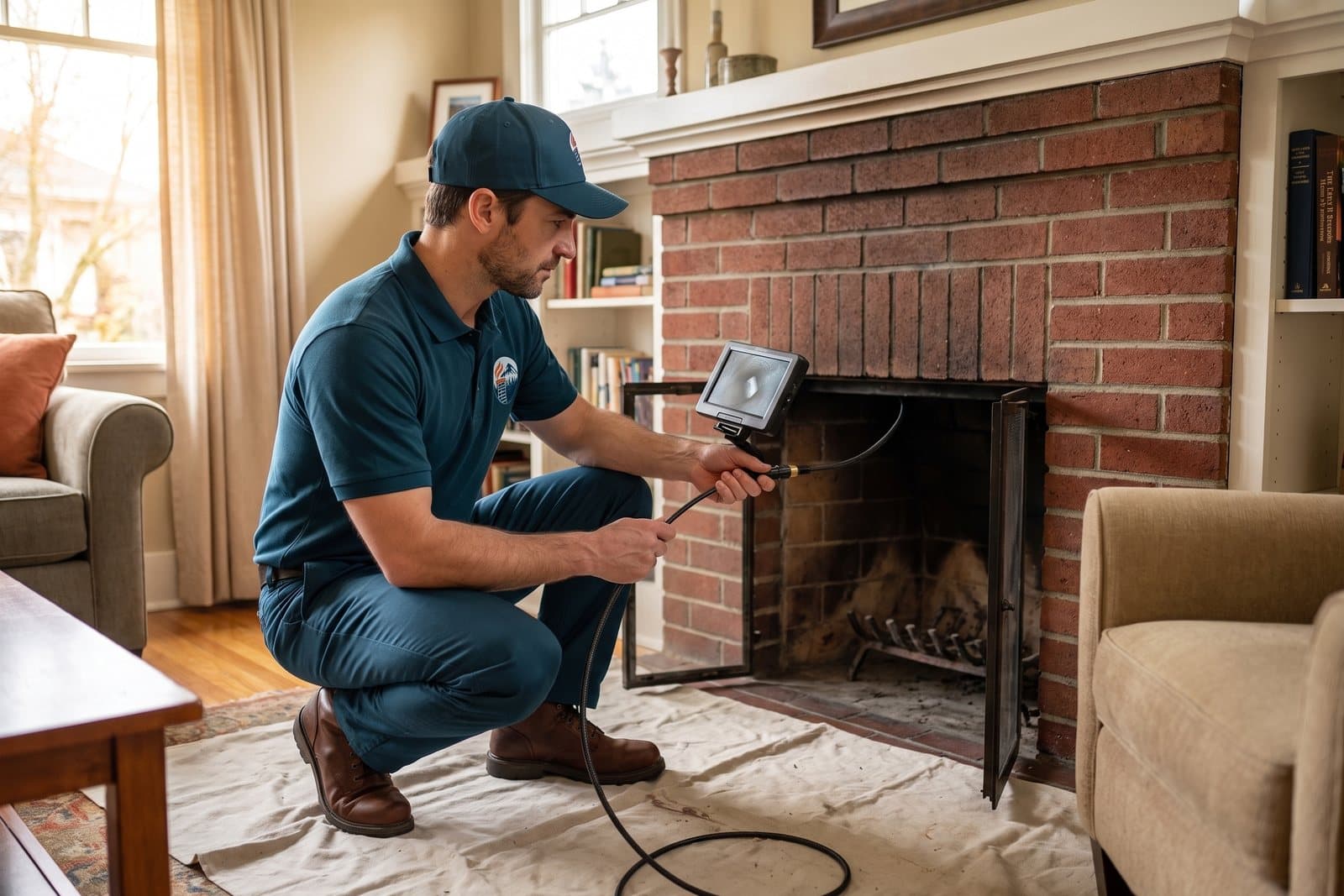
Most relining starts with something the homeowner is changing or something an inspection has found. NFPA 211 and CSIA call for a Level II inspection, including a video scan, ahead of any relining job, and again whenever a new or different kind of appliance is connected. The camera is what shows whether the existing tiles can be kept.
| Situation | Why a liner comes up | Typical outcome |
|---|---|---|
| Adding a wood or pellet insert | The insert needs a flue sized to its outlet | Stainless liner from insert to top |
| Converting a fireplace to gas | Cool, moist gas exhaust condenses in large flues | Liner rated for gas, sized to the unit |
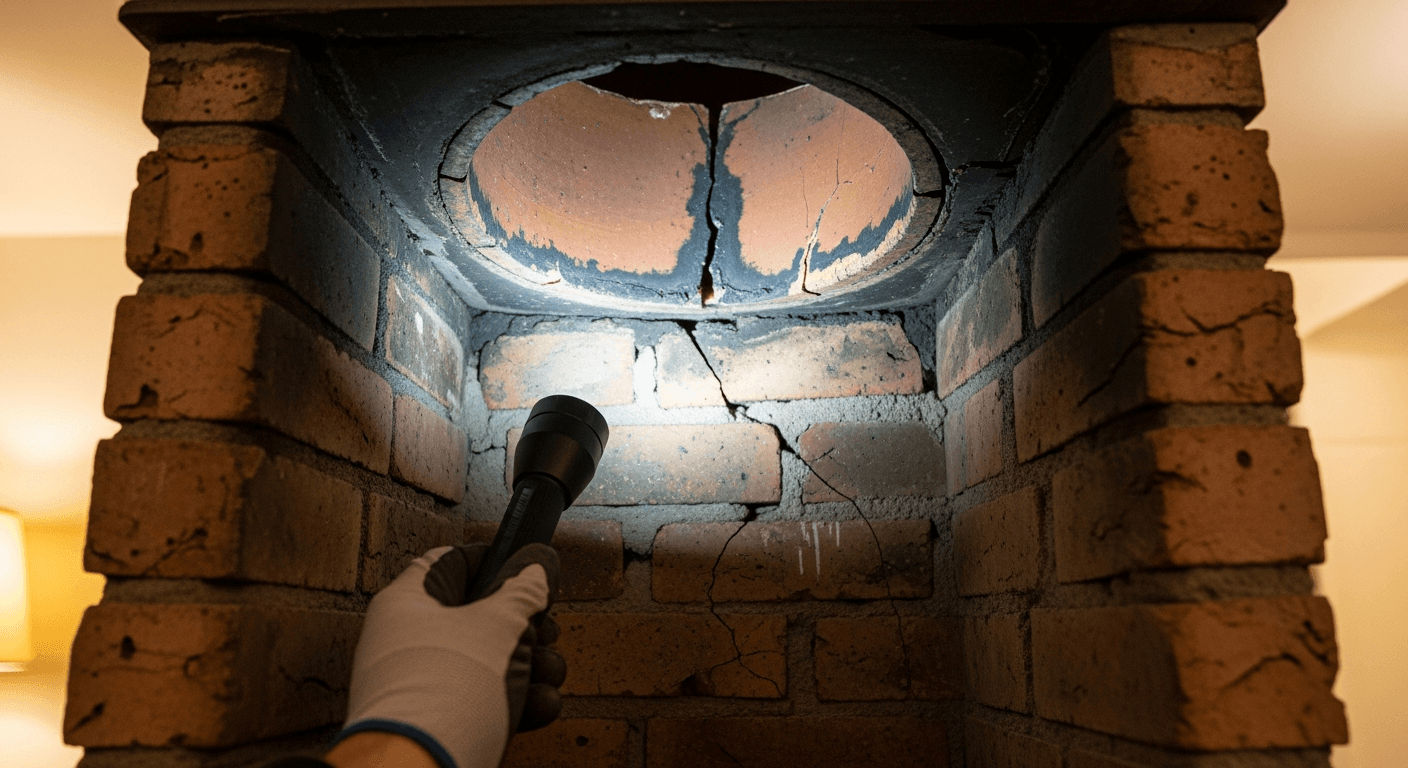
| Cracked or offset clay tiles on camera | Heat and gases can reach the brick and framing | Stainless or cast-in-place relining |
| After a chimney fire | Tiles often crack from the sudden heat | Level II inspection, then relining |
| After an earthquake | Joints separate inside the stack | Inspection before the next use |
| Very old chimney with no liner | Code expects a lining for any appliance | New liner before the flue is used |
Why Tacoma has so many candidates
Tacoma's housing is old for the region. Census estimates for 2020 to 2024 show about 26.9 percent of its units built in 1939 or earlier, well above the county's 10.1 percent, and about 64 percent built before 1980. In Fircrest, which grew mostly after the war, roughly three-quarters of units predate 1980. A good share of those flues started life serving an open hearth and now carry an insert, a furnace or gas logs instead.
Earthquakes add a local reason. The 2001 Nisqually quake, magnitude 6.8 and centered beneath Anderson Island, left chimney damage in a third of the 30,000 homes FEMA inspected, according to USGS. Much of that kind of damage sits inside the flue, where only a camera finds it.
Liner types and where each fits
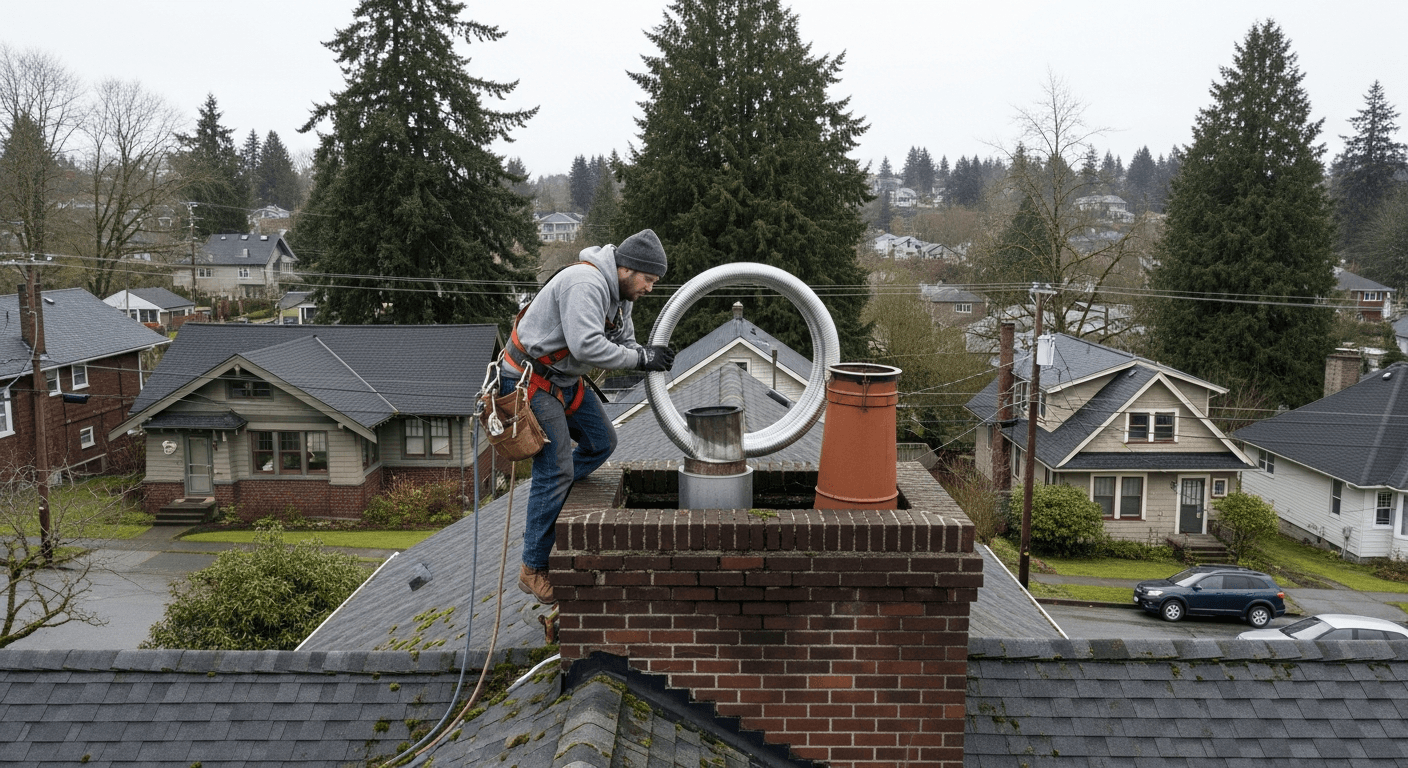
Stainless steel is the most common choice for relining. It comes as flexible or rigid pipe, is sized to the appliance and is suited to wood, gas and oil when the correct grade is used. Cast-in-place liners pour a heat-resistant mix around a form inside the old flue, which can add strength to a chimney with deteriorated interior masonry. Replacing clay tile is possible but usually means opening the chimney, so it is chosen less often for an existing house.
| Liner type | Good fit | Limits |
|---|---|---|
| Stainless, flexible | Inserts, offsets in the flue, gas conversions | Must be the right grade for the fuel |
| Stainless, rigid | Straight flues, high-use wood stoves | Needs a straight run |
| Cast-in-place | Deteriorated interior masonry | More labor, longer cure time |
| New clay tile | New construction or a full rebuild | Hard to install in an existing chimney |
What relining runs
Our chimney relining starts at $1,900 and reaches $5,900 for the tallest or most involved flues. The number depends on the flue height, the liner type and diameter, and whether the flue needs cleaning or enlarging first. It is quoted in writing after an inspection, which costs $99 plus tax and is credited toward the relining when you sign off on the quote.
No South Sound chimney business we looked at posts a price for the liner alone. Horizon Chimney Sweep in Gig Harbor publishes a price for installing a fireplace insert together with its liner, which includes the insert itself. Nationally, Fixr gives $1,800 to $4,000, HomeAdvisor $1,500 to $5,000 and Bob Vila $625 to $7,000. None of those is our quote, and they do not all describe the same scope.
Frequently asked questions
Can I see whether my chimney has a liner myself?
Sometimes. With the damper open and a flashlight, clay tile shows as square or round sections with joints every couple of feet. Bare brick in the flue, or no visible tile at the top, suggests there is none. A camera settles it.
Does a new liner fix a fireplace that smokes?
It can, when the problem is a flue that is too large, broken or leaking. A liner sized to the appliance speeds up the exhaust and improves draw. It will not fix a downdraft caused by a chimney that is too short.
Do I need a permit to reline in Tacoma?
Installing any solid fuel appliance in Tacoma, from a pellet stove to a masonry heater, needs a building permit first. For a liner-only job, ask the city whether the work falls under that permit or not.
How long does relining take?
A stainless liner in a straightforward chimney is often a one-day job once the flue is cleaned and measured. Cast-in-place systems, or a flue that must be enlarged first, take longer.
Sources
- UpCodes — WA Residential Code, Chapter 10 — accessed September 24, 2026
- City of Tacoma — Tip Sheet B-292 — accessed September 24, 2026
- NFPA 211 — inspection levels input — accessed September 24, 2026
- CSIA — Level 2 inspection procedure — accessed September 24, 2026
- Census Reporter — ACS year built — accessed September 24, 2026
- USGS — Nisqually earthquake report — accessed September 24, 2026
- PNSN — 2001 Nisqually Earthquake — accessed September 24, 2026
- Horizon Chimney Sweep — Gig Harbor services — accessed September 24, 2026
- Fixr — Chimney Liner Installation Cost — accessed September 24, 2026
- HomeAdvisor — Chimney Liner Cost — accessed September 24, 2026
- Bob Vila — Chimney Liner Cost — accessed September 24, 2026
Related services