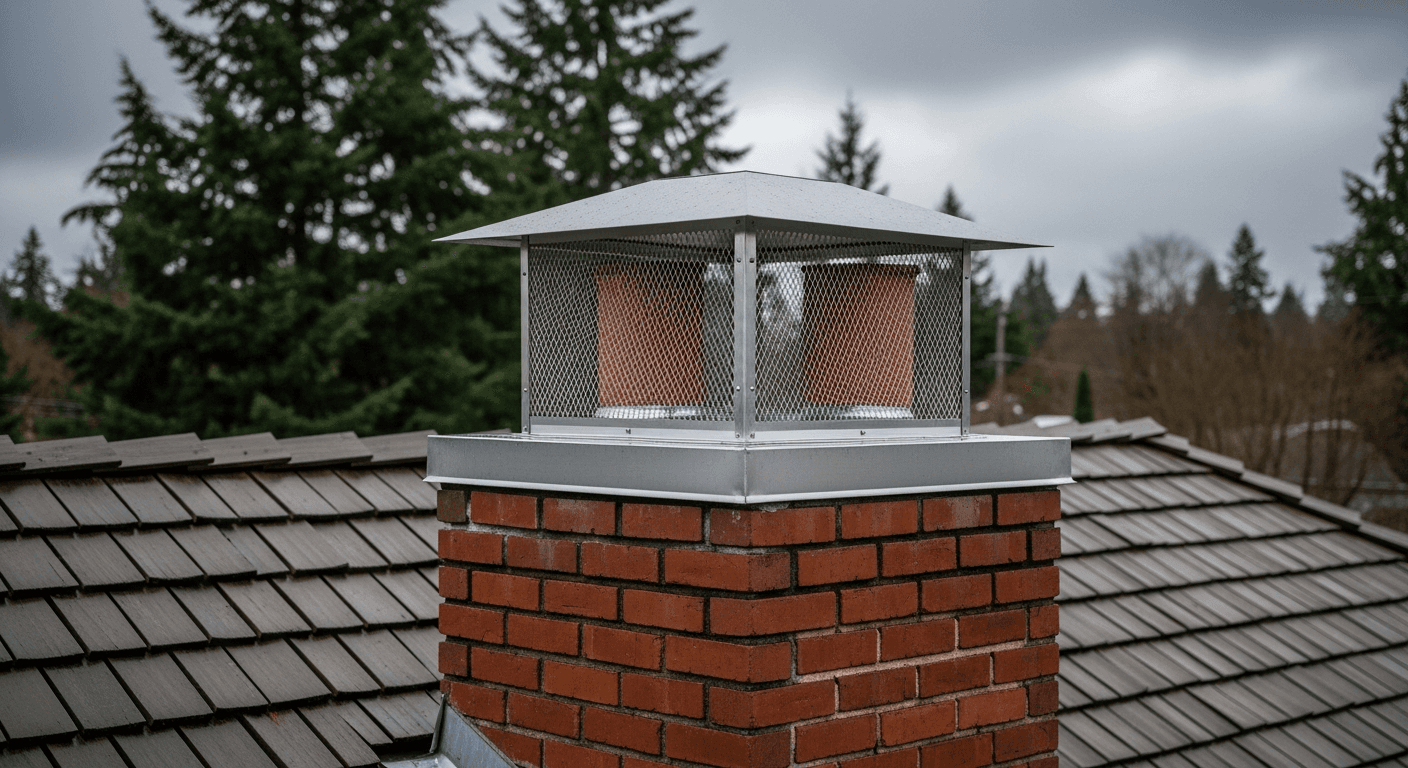
A chimney cap is the small metal hood that sits over the top of the flue. It looks like an accessory, but it does four jobs: it sheds rain that would otherwise fall straight down the chimney, it keeps birds and raccoons out, it catches embers before they land on the roof, and it reduces the downdrafts that blow smoke back into the room on gusty nights. In Tacoma, with rain on the calendar from October into May and fall storms arrive from the south, those jobs are not theoretical. Here is what each one protects, how cap types differ, and how to tell when yours has stopped working.
The four things a cap keeps out
An uncapped flue is an open pipe pointed at the sky. Every storm drops water directly onto the smoke shelf and damper, where it rusts metal parts and soaks into the mortar of the firebox. Animals find the same opening; a nest in the flue blocks the smoke path and can catch fire. Embers rising from a hot fire can land on moss or needles on the roof. And wind blowing across an open top can push smoke back down.
When the State Fire Marshal lists steps for safe home heating, it pairs annual inspection and cleaning with a chimney cap, which says something about how often the missing cap shows up after the fact.
| Threat | What happens without a cap | What the cap does |
|---|---|---|
| Rain | Water on the damper, smoke shelf and flue tiles | Hood deflects it past the flue opening |
| Birds and animals | Nests and debris block the flue | Mesh sides close the opening |
| Embers | Sparks settle on the roof or nearby trees | Screen holds them back until they burn out |
| Wind | Gusts push smoke back into the room | Hood breaks up air blowing across the top |
Why Tacoma chimneys take more weather
WeatherSpark counts about 6.7 months of wetter weather in Tacoma, from roughly October 10 to May 1, with November the wettest month at about 7.7 inches of rain on average. The Western Regional Climate Center's Tacoma station recorded an average of 39.76 inches of rain and snow annually over 1982 to 2016. For most of that season, an open flue is taking water on most days.
Wind overlaps with the rain. WeatherSpark's windier period in Tacoma runs from mid-October to late April, and the prevailing direction from about September to June is from the south. A cap facing that exposure has to be fastened properly; a loose one ends up in the gutter or the yard after the first real storm.
Cap types and where each fits
Most masonry chimneys with one clay flue take a single-flue cap that clamps to the liner. A chimney carrying two or three flues, such as a fireplace and a furnace, usually needs a larger cover that bolts to the crown and spans all of them. A top-mount damper combines a cap with a spring-loaded plate that seals the top of the flue when the fireplace is off, which also stops warm room air from escaping.
Material matters in this climate. Stainless steel resists corrosion; galvanized steel is cheaper at first but rusts in a place that stays damp for more than half the year. Copper is durable and chosen mostly for appearance on older homes.
| Cap type | Typical use | Trade-off |
|---|---|---|
| Single-flue, clamp-on | One clay liner, the common case | Must match the liner size |
| Multi-flue cover | Several flues in one chimney | Larger, mounts to the crown |
| Top-mount damper cap | A damper that is rusted or missing | Has a cable and handle in the firebox |
| Galvanized steel | Short-term budget fix | Rusts sooner in damp weather |
What the Washington code says about spark screens
The 2021 Washington State Residential Code, in effect since March 15, 2024, covers chimney termination. Where a spark arrestor is installed, its openings must stop anything larger than half an inch while letting a 3/8-inch sphere through, and the screen has to be removable so it can be cleaned. The same section sets the height a masonry chimney must reach: a minimum of 3 feet over the point where it exits the roof, and a 2-foot margin over anything on the house that sits within a 10-foot radius.
The cleaning clause is the practical one. Mesh that is too fine, or that is never brushed, collects soot and creosote until the fire stops drawing properly.
Signs your cap needs attention
Water dripping into the firebox after rain, a rusty streak running down the crown, chirping or scratching inside the flue, a cap visibly tilted after a windstorm, or smoke that rolls back into the room on gusty nights are the usual clues. Binoculars from the sidewalk are enough to see whether a cap is still there and still straight.
What installation runs
Our cap installation is priced from $265 to $750; a stainless single-flue cap sits at the lower end, and a multi-flue or custom-fit cover moves the job up. For national context, Fixr lists $300 to $600 for cap replacement and HomeAdvisor's normal range is $75 to $500. We did not find a South Sound company that publishes a cap price, so those are the closest published market figures, and none of them is our quote.
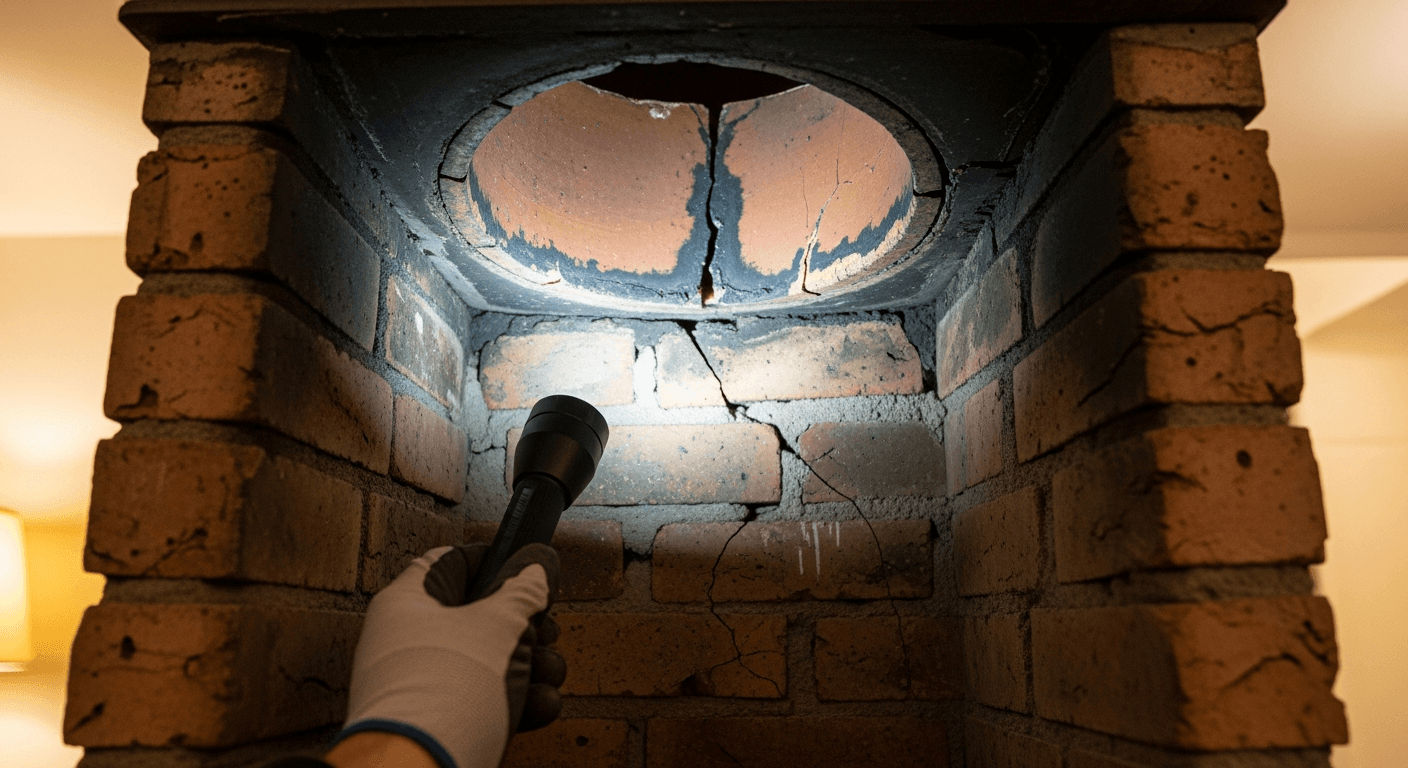
If a technician is already on the roof, it is worth having the crown under the cap looked at, because a new cap on a cracked crown only solves half the water problem. An inspection is $99 plus tax and is deducted from the job once you accept its written quote.
Frequently asked questions
Does a gas appliance flue need a cap too?
Yes. A gas vent or liner needs a termination cap listed for it, and rain or a nest in that flue is just as unwelcome. The type differs from a masonry chimney cap, so match it to the appliance.
Can a cap make my fireplace draw worse?
A correctly sized cap should not. Trouble usually comes from a mesh clogged with soot or a cap sitting too low over the flue. Cleaning the screen or fitting the right height typically fixes it.
Is a spark screen required in Washington?
The state residential code does not force one on every chimney; if a spark arrestor is fitted, though, it sets the opening size and requires the screen to come off for cleaning.
How long does a stainless cap last?
Much longer than a galvanized one, which tends to rust through in a climate that stays damp for half the year. Wind damage and loose fasteners are the more common reasons to replace stainless.
Sources
- WeatherSpark — Tacoma climate — accessed September 24, 2026
- WRCC — Tacoma #1 monthly summary — accessed September 24, 2026
- UpCodes — WA Residential Code, Chapter 10 — accessed September 24, 2026
- WA SBCC — 2021 codes effective date — accessed September 24, 2026
- WA State Fire Marshal — Home heating safety — accessed September 24, 2026
- Fixr — Chimney Cap Replacement Cost — accessed September 24, 2026
- HomeAdvisor — Chimney Cap Cost — accessed September 24, 2026
Related services