
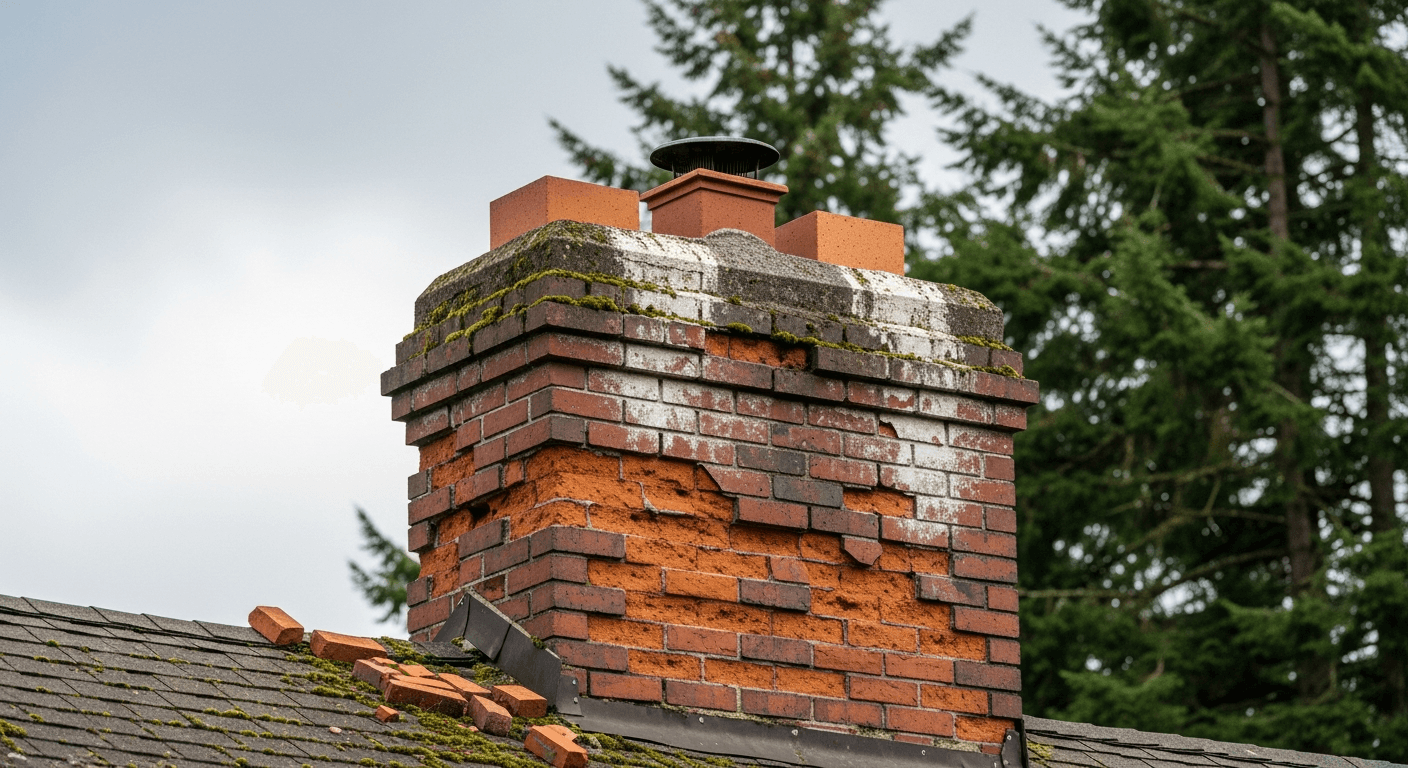
Your chimney is damaged — or heading there — if you spot spalling brick, a crumbling crown, white mineral staining on the exterior, or water marks inside the firebox. In Tacoma, where annual rainfall averages 38 inches and salt-laden air off Commencement Bay accelerates mortar breakdown, most masonry chimneys on Craftsman-era homes show at least one of these signs within 20 to 30 years of their last maintenance. Catching them early is the single biggest factor in keeping repair bills under four figures rather than over them.
Six Warning Signs Tacoma Homeowners Can Spot From the Ground or Inside the House
You do not need to get on the roof to catch most early chimney problems. Start from the ground and work your way inward.
Spalling brick is your most visible clue. When moisture penetrates Tacoma's older lime-mortar masonry and freezes, it forces the brick face to flake and fall. Find orange or red brick fragments on your roof surface or in the plantings below the chimney base and you are looking at active spalling — the masonry is absorbing more water than it can shed.
White chalky deposits on the brick exterior — efflorescence — are mineral salts left behind as water moves through the chimney wall and evaporates on the surface. Efflorescence alone is not a structural emergency, but it is a reliable indicator that water is traveling through your chimney walls every time it rains.
A cracked or missing chimney crown is among the most common deficiencies we find on Tacoma homes built before 1960. The crown seals the top of the masonry stack around the flue opening. Tacoma's cycle of wet, cold winters followed by dry summers cracks and gaps crown mortar over time. A quarter-inch crack is enough to channel rainwater straight down the flue.
Inside the house, inspect the firebox walls and damper. A rusted damper plate confirms moisture entry. Water stains or peeling paint on the wall or ceiling near the chimney breast — especially on upper floors — points to water tracking down the outside of the flue liner or through deteriorated flashing where the chimney meets the roofline.
Pay attention to odors. A musty or smoky smell from the fireplace when it is not in use, particularly in Tacoma's wet fall and winter months, usually signals moisture or creosote accumulation inside the flue. A sharp or acrid smell during burning can indicate a cracked liner allowing combustion gases to escape into the chase rather than vent out the top.
Why Tacoma's Older Homes Face These Problems Sooner Than You'd Expect
A substantial share of Tacoma's housing stock dates from the 1910s through the 1950s — Craftsman bungalows, brick foursquares, and early wood-frame homes built with original clay-tile-lined masonry chimneys. Those clay tile liners were engineered for roughly 50 to 60 years of regular use. Many are now 70 to 100 years old and have not been relined or meaningfully repaired.
Tacoma's proximity to Commencement Bay means chimneys here are regularly exposed to salt-laden marine air in addition to the region's 38 annual inches of rain. That combination eats lime-based mortar — the standard joint material in pre-war construction — significantly faster than it would in an inland climate. Mortar joints erode, recess, and eventually gap, opening a direct pathway for water into the interior of the chimney stack.
A Tacoma homeowner with a 1930s or 1940s Craftsman should not assume a chimney is sound simply because it appears solid from the sidewalk. Chimneys on homes of this age should have been inspected and typically relined or repointed within the last 15 to 20 years. If that work has not been documented, the probability of finding at least one serious deficiency on inspection is high.
Common Chimney Symptoms and What They Indicate
Understanding what each visible symptom actually means helps Tacoma homeowners prioritize repairs correctly. The table below maps the most frequently observed chimney warning signs to their underlying causes and the urgency level each carries.
| Visible Symptom | Most Likely Cause | Secondary Cause to Rule Out | Urgency for Tacoma Homes |
|---|---|---|---|
| Brick fragments on roof or ground below chimney | Freeze-thaw spalling from water infiltration | Seismic or impact damage | High — active masonry loss accelerates quickly |
| White chalky staining on chimney exterior (efflorescence) | Water migrating through chimney wall and evaporating | Salt-laden marine air from Commencement Bay | Moderate — indicator of water movement, not yet structural |
| Cracked or gapped chimney crown | Tacoma's wet-dry seasonal cycling | Age-related mortar shrinkage (common pre-1960 homes) | High — direct water entry into flue |
| Rusted damper plate | Chronic moisture entry through crown or flashing | Condensation from gas appliance venting | Moderate — confirms water intrusion, damper may not seal |
| Water stains on ceiling or wall near chimney breast | Deteriorated flashing at roofline | Water tracking down outside of cracked flue liner | High — interior water damage compounds quickly |
| Musty or smoky odor when fireplace not in use | Moisture or creosote accumulation in flue | Negative air pressure drawing flue air into home | Moderate-High — investigate before rainy season |
| Acrid smell during burning | Cracked liner allowing gases into chase | Blocked or undersized flue | Critical — stop use, safety risk |
| Mortar joints recessed or missing between bricks | Long-term lime-mortar erosion from rain and marine air | Differential settling of chimney stack | High — open joints allow rapid water infiltration |
| Chimney leaning or separating from house | Foundation settling or severe mortar failure | Seismic movement | Critical — do not use fireplace, structural hazard |
A Tacoma Homeowner's Situation: Catching It Before the Big Bill
Consider a hypothetical but representative scenario: a homeowner in Tacoma's North End notices a persistent damp smell from the fireplace every time it rains in October. The house is a 1924 Craftsman that has changed hands twice in the previous decade. From the sidewalk, the chimney looks intact — solid brick, no obvious gaps or missing sections.
An inspection in this type of situation commonly finds three visible cracks running across the crown and mortar joints in the top four brick courses recessed nearly a full inch in places. Water tracks down the inside of the original clay tile liner, and tile sections show hairline fractures consistent with repeated freeze-thaw stress over multiple winters.
The repair — crown resurfacing, repointing the deteriorated mortar joints, and a penetrating waterproofing application — comes to just under $1,100 in this scenario. Had the homeowner waited another full winter, the fractured liner tiles would have required complete stainless steel relining of the flue, adding $2,500 to $4,500 to the total. A damp smell in October can be an early warning that saves a significant bill.
What Chimney Damage Repairs Actually Cost in Tacoma in 2025
Repair costs depend heavily on what you find and how early you find it. The figures below reflect actual work in Tacoma and Pierce County — not national averages that routinely understate local labor and material costs.
The single most consequential cost variable is whether structural damage has reached the liner. Crown repairs and waterproofing are comparatively affordable. Once the liner is compromised, costs jump because stainless steel liner systems require specialized materials and more labor-intensive installation through an existing chimney stack.
Before authorizing any repair, ask for a written scope of work tied to documented inspection findings. A Level 2 chimney inspection — the standard for any chimney showing signs of damage — produces a written assessment identifying what is wrong, what caused it, and what repair is warranted. A quote offered without that documentation is a red flag.
| Repair Type | Typical Tacoma Cost Range | Urgency Level | DIY Feasible? |
|---|---|---|---|
| Chimney sweep and inspection (annual) | $149 – $249 | Routine / preventive | No |
| Crown crack repair / resurfacing | $300 – $700 | High — complete before rainy season | No |
| Mortar joint repointing (tuckpointing) | $500 – $1,500 | High — stops active water intrusion | No |
| Chimney waterproofing (penetrating sealant) | $200 – $500 | Moderate — best applied preventively | No |
| Flashing repair or replacement | $400 – $1,200 | High — most common source of interior leaks | No |
| Partial liner repair (tile crack stabilization) | $600 – $1,500 | High — safety concern | No |
| Full stainless steel relining (replaces clay tile) | $2,500 – $5,500 | Critical — required before use | No |
| Spalling brick replacement (partial) | $800 – $2,500 | Moderate to high | No |
| Full chimney rebuild above roofline | $4,000 – $10,000+ | Critical | No |
When to Call Immediately Versus When You Have a Little Time
Some chimney problems require you to stop using the fireplace now. If you see daylight through the firebox wall, smell smoke or combustion gases when the fireplace is not in use, notice the chimney stack leaning or separating from the house, or find large brick or mortar pieces on the ground below the chimney, do not light another fire until a professional inspection is completed.
A cracked flue liner is a safety issue before it is a structural one. Fractured clay tile can allow carbon monoxide and combustion gases to migrate laterally into living spaces rather than venting upward. This is not a problem to schedule for spring.
Problems that allow a short window but still require attention before Tacoma's rainy season — which typically intensifies from October through March — include: minor crown cracking without open gaps, efflorescence without confirmed active leaking, a stiff or lightly rusted damper, and mortar joints that are recessed but not yet fully open. These are fall-priority repairs.
Cosmetic issues — surface soot on brick faces, minor weathering discoloration — can reasonably wait for your next scheduled sweep and inspection without risk of accelerating structural damage.
Frequently asked questions
How often does a chimney in Tacoma need to be cleaned and inspected?
A wood-burning fireplace in Tacoma that is used regularly requires an annual sweep and inspection at minimum — that is the standard set by NFPA 211. In Tacoma, where rain and marine air accelerate crown and mortar deterioration year-round, an annual visual of the crown and flashing is worth the cost even for fireplaces used only a few times each season. Gas appliances vented through a masonry chimney in Tacoma still require annual inspection, though not necessarily sweeping.
Will homeowners insurance cover chimney repairs in Tacoma?
Coverage for chimney repairs in Tacoma depends on the cause. Most policies pay for chimney damage from a sudden event — a windstorm damaging the cap, a lightning strike, a house fire. Gradual deterioration, deferred maintenance, and wear-and-tear damage such as spalling brick or a crumbling crown are almost universally excluded. Some policies cover interior water damage if it resulted from a covered storm event, but not from a neglected crown or flashing. Keeping records of annual chimney inspections strengthens your position if you ever need to file a claim.
What should a chimney sweep cost in Tacoma?
A legitimate sweep and inspection for a standard single-fireplace system in Tacoma runs $149 to $249. Advertised prices below $99 frequently function as loss-leader inspections structured around upselling repairs of questionable necessity. A fair-priced chimney service in Tacoma includes cleaning of the firebox and accessible flue, inspection of the damper, liner, and crown, and a written summary of findings.
What is the most expensive chimney repair Tacoma homeowners typically face?
Full stainless steel relining is the most common large chimney repair bill for Tacoma homeowners, typically $2,500 to $5,500 for a standard residential flue. Relining becomes necessary when the original clay tile liner is cracked, spalled, or incorrectly sized for a replacement appliance. A full chimney rebuild above the roofline — less common and almost always the result of years of deferred maintenance — can reach $4,000 to $10,000 or more depending on stack height and the extent of masonry failure.
Can I inspect my own chimney from the roof?
Ground-level observation of a Tacoma chimney catches obvious problems — spalling brick, fallen mortar fragments, visible crown cracking, efflorescence staining. Evaluating the flue liner requires a camera or bright light source and the experience to interpret what you see. Steep-pitched rooflines are common on Tacoma's older Craftsman homes, and fall risk is real. For anything beyond a ground-level visual, a certified chimney professional with camera inspection equipment will give a Tacoma homeowner an accurate and safe assessment.
Related services


