Yes — a Tacoma chimney needs tuckpointing when mortar joints have eroded a quarter inch or more, and in Pierce County's climate that threshold arrives sooner than most homeowners expect. Test it by pressing a key into the joint; if it sinks without resistance, the work is overdue. Pierce County's wet winters deliver 38 to 40 inches of rain annually, and the freeze-thaw cycles that run from November through March attack mortar relentlessly; catching deterioration at the tuckpointing stage rather than waiting for brick replacement typically saves homeowners three to five times the cost.
Why Tacoma chimneys deteriorate faster than most homeowners expect
Tacoma's position on Commencement Bay means chimneys in the Proctor, North End, and Stadium Districts absorb salt-laden marine air year-round. Salt is one of the most aggressive accelerants of mortar breakdown — it pulls moisture into the joint, then expands as it crystallizes, widening micro-cracks with each cycle. Combined with Pierce County's 38 to 40 inches of annual rainfall and repeated freeze-thaw swings between November and March, local conditions age mortar two to three times faster than drier inland climates in Eastern Washington.
Tacoma's older housing stock compounds the problem. The Craftsman bungalows and foursquares built throughout the North End, Proctor, and South Tacoma neighborhoods between roughly 1900 and 1940 were constructed with full masonry chimneys using soft lime-based mortar — a mix intentionally designed to flex with the structure rather than resist it rigidly. By the time those chimneys reach 60 to 80 years of age without professional maintenance, the joints are frequently well past the threshold where tuckpointing alone resolves the damage.
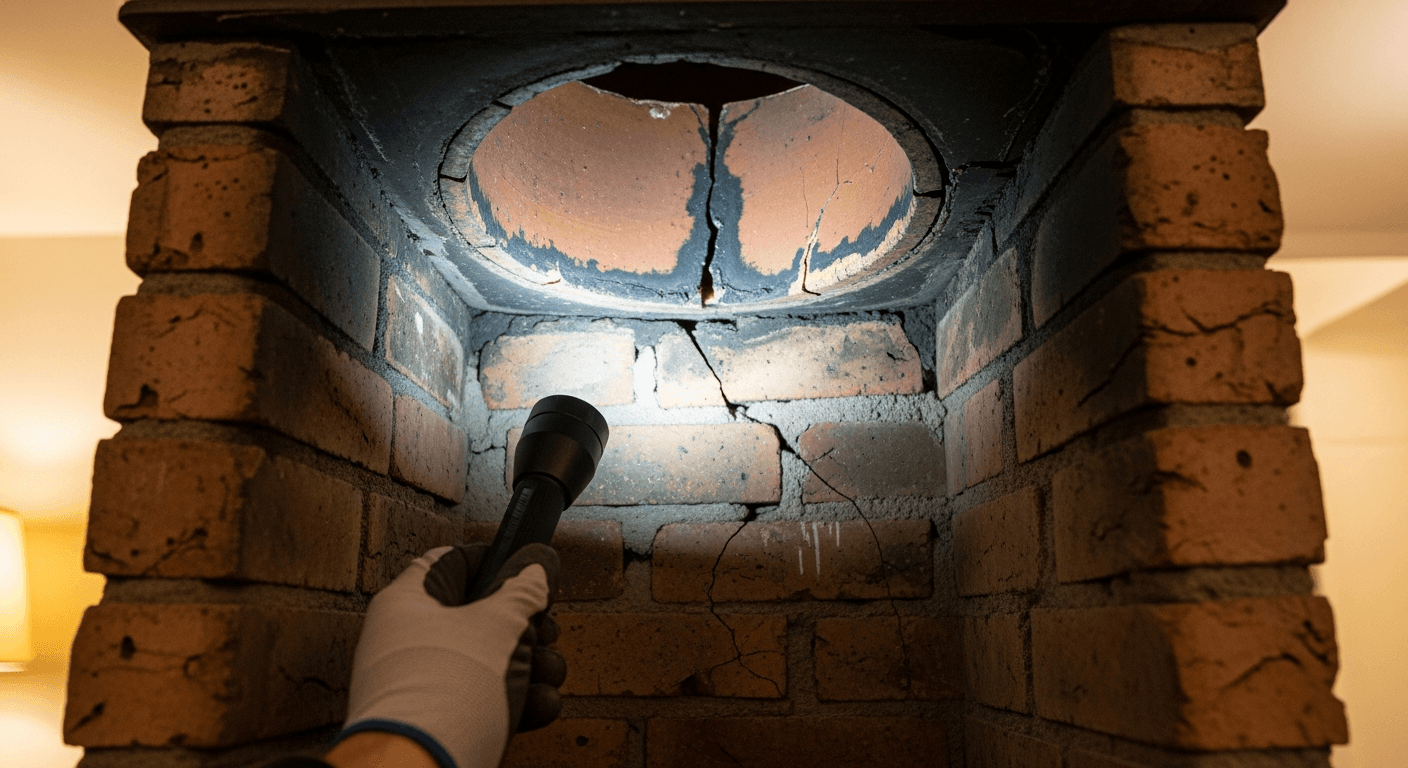
From the ground, look for three specific warning signs: white mineral streaking (efflorescence) running down the brick face, which indicates water is actively moving through the masonry; mortar joints that appear recessed or sandy rather than flush and dense; and brick faces that have begun to flake or chip. Inside, rust-colored staining on firebox walls often signals water entering through deteriorated exterior masonry rather than through the flue itself — a distinction that matters for diagnosing the right repair.
Tuckpointing vs. full masonry repair — what is actually the difference?
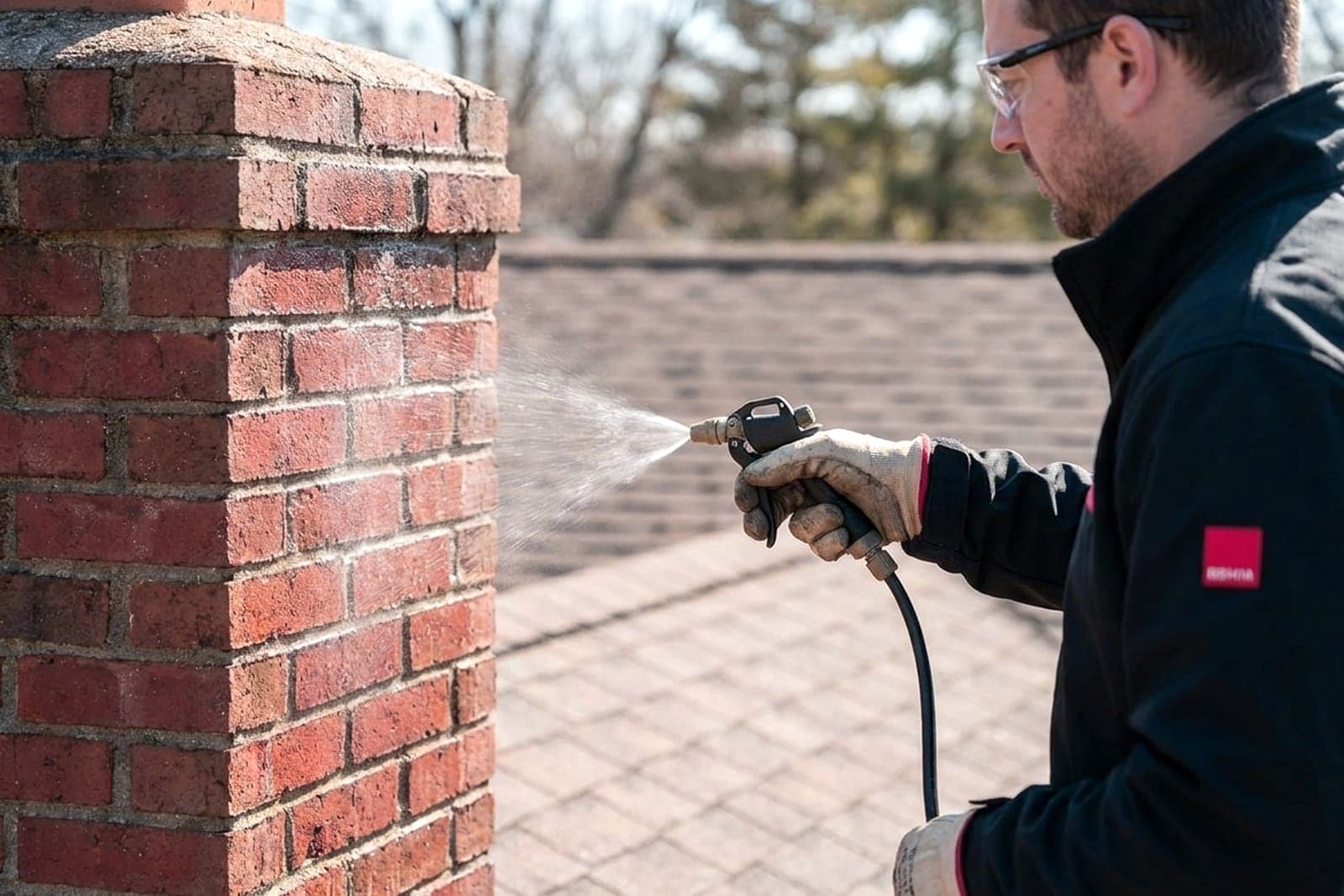
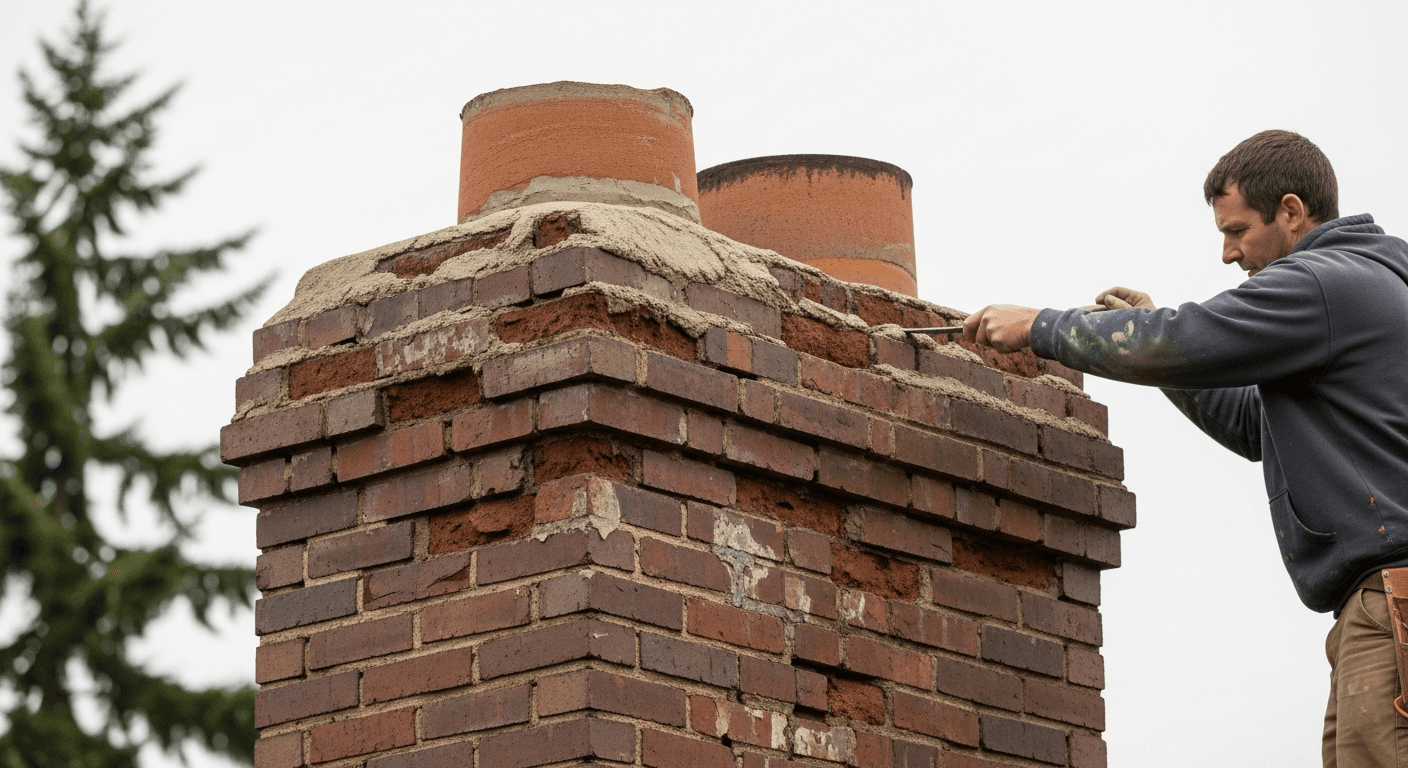
Tuckpointing is a targeted preservation technique: deteriorated mortar is ground or chiseled out to a depth of approximately three-quarters of an inch, and fresh mortar matched to the original mix is packed into the cleaned joint. When performed on a chimney with structurally intact brick, proper tuckpointing extends masonry life another 20 to 30 years. It does not rebuild — it restores.
Full masonry repair is required when individual bricks have spalled severely enough to lose their weather-tight face, when courses have begun to shift or lean, or when water infiltration has caused mortar failure across entire sections of the stack rather than in isolated joints. Damaged bricks must be removed and replaced with material that closely matches the original — a real sourcing challenge with early-1900s Tacoma brick, which was often produced at regional kilns no longer in operation.
Between those two scopes sits the partial stack rebuild — one of the most common repairs on older Tacoma chimneys. When the top three to six courses have deteriorated beyond tuckpointing but the lower structure remains sound, a mason tears down and relays only the compromised upper section. Freeze-thaw damage concentrates at the most exposed portion of the stack, making this a repair we see repeatedly on North End and Stadium District homes after a hard winter.
The mortar mix is not a minor detail, particularly for pre-1940 Tacoma homes. Modern Portland cement mortar is significantly harder than the original lime-based mix. Applied as tuckpointing material on century-old brick, the rigid new mortar holds firm while the softer surrounding brick absorbs the stress and begins to crack and spall — accelerating the very damage the repair was meant to stop. Matching the lime-to-sand-to-cement ratio to the original is essential; a good mason will sample and test the existing mortar before mixing the replacement batch.
What does chimney tuckpointing and masonry repair cost in Tacoma?
Cost is driven by how much of the chimney is affected, how accessible the stack is from the roof, and whether structural work is required alongside mortar repair. The table below reflects current Tacoma-market price ranges based on actual job scope — not national averages adjusted downward.
Scaffolding surprises many homeowners. A two-story Craftsman in the North End with a chimney rising four feet above the ridge often cannot be safely worked from a ladder alone; scaffolding or a lift adds $150 to $400 to the job and is non-negotiable for safe, quality work at that height. Ask any mason directly how they plan to access the stack before accepting a quote — ladder-only bids on tall chimneys are a warning sign.
Scheduling affects quality, not just price. Mortar requires sustained temperatures above 40 degrees Fahrenheit to cure correctly, which in Tacoma means late spring through early fall — May through September — is the reliable work window. Masonry repair attempted during a February cold snap risks premature mortar failure and a repeat job within two seasons. If you spot deterioration in October, schedule the inspection and quote before winter closes in, then book the repair for spring.
| Repair Type | Typical Scope | Tacoma Price Range | Timeframe |
|---|---|---|---|
| Tuckpointing (minor) | Up to 10 sq ft of joints, single face | $300 – $600 | Half day |
| Tuckpointing (moderate) | Full chimney exterior, all four faces | $600 – $1,200 | 1 day |
| Tuckpointing (extensive) | Full chimney, severely eroded joints throughout | $1,200 – $2,000 | 1–2 days |
| Individual brick replacement | 5–15 spalled or damaged bricks | $400 – $900 | Half to 1 day |
| Partial stack rebuild (top 3–6 courses) | Deteriorated upper section, lower structure sound | $1,200 – $2,500 | 1–2 days |
| Full exterior masonry repair | Structural damage across multiple sections | $2,500 – $5,500+ | 2–4 days |
| Scaffolding surcharge (when required) | Two-story or difficult roofline access | $150 – $400 | Included in job |
How urgently does each warning sign require action? A symptom-to-cause guide for Tacoma homeowners
Not every visible chimney problem carries the same urgency, but Tacoma's climate compresses timelines — a cosmetic issue in September can become a structural problem by March. The table below maps the most common warning signs to their likely cause and the recommended response window, so homeowners can prioritize correctly rather than either panicking or delaying.
The single most important distinction is between symptoms that indicate active structural movement — which require professional evaluation before the fireplace is used again — and symptoms that indicate mortar deterioration, which can typically be monitored through one inspection cycle before repair becomes urgent. Efflorescence falls into neither emergency category on its own, but it is almost always the first visible surface indicator that mortar damage is progressing underneath.
| Warning Sign | Most Likely Cause | Urgency Level | Recommended Action |
|---|---|---|---|
| White mineral streaking (efflorescence) on brick face | Water moving through mortar joints and depositing salts | Moderate — schedule within 60 days | Professional inspection; mortar assessment at roof level |
| Mortar joints visually recessed or sandy | Advanced mortar erosion from freeze-thaw cycling | High — schedule before next winter | Key-press test; tuckpointing if penetration exceeds ¼ inch |
| Brick faces flaking or chipping (spalling) | Loss of fired outer layer; moisture entering porous interior | High — do not delay past one season | Brick replacement or partial rebuild depending on extent |
| Chunks of brick accumulating at base of chimney | Severe spalling or course displacement at top of stack | High — inspect roofline immediately | Hands-on roof-level inspection; likely partial rebuild |
| Rust staining inside firebox walls | Water entering through deteriorated exterior masonry | Moderate-High — inspect before next fire | Exterior masonry inspection to identify infiltration point |
| Horizontal cracks running along mortar courses | Structural movement or settlement in the stack | Emergency — do not use fireplace | Professional structural evaluation before any further use |
| Stack visibly leaning or tilting | Foundation settlement or severe structural failure | Emergency — do not use fireplace | Immediate professional evaluation; potential full rebuild |
A North End homeowner called us when her 1924 Craftsman chimney started shedding brick
A homeowner on North 30th Street in Tacoma's North End contacted us after finding small chunks of brick accumulating on her back porch each spring. Her 1924 Craftsman had a full masonry fireplace chimney that had never been professionally tuckpointed in the 22 years she had owned the home. From the ground, the mortar joints near the top of the stack looked dark and slightly recessed — she assumed it was cosmetic discoloration from weather exposure.
Once on the roof, the condition was more serious. The top six courses had mortar joints eroded to more than half an inch in places, and three bricks on the south-facing side — the face that absorbs the most direct rain and sun cycling — had spalled deeply enough that water was pooling behind the brick face rather than draining away. Two of those three bricks shifted noticeably when pushed by hand.
The appropriate scope was a partial rebuild of the top six courses combined with full tuckpointing of the remaining exterior, using a soft lime mortar mix matched to the original rather than modern Portland cement, which would have been mechanically incompatible with the 100-year-old brick. Total cost came to just under $2,100 including scaffolding. She mentioned that another contractor had quoted approximately $6,000 to tear down and rebuild the entire chimney above the roofline — a scope that a close inspection showed was not supported by the actual condition of the lower two-thirds of the stack.
This illustrative scenario shows the value of an inspection that puts eyes directly on the masonry at roof level. The difference between a $2,100 targeted repair and a $6,000 unnecessary rebuild was simply the difference between a ground-level assumption and a hands-on assessment.
How to know if your Tacoma chimney needs masonry work now or can wait
Most homeowners cannot judge mortar joint depth accurately from the ground, and joint depth is the key diagnostic variable. If joints look visually recessed, press a key or flat screwdriver into the joint at arm's reach from a ladder: penetration of more than a quarter inch without meaningful resistance means tuckpointing is overdue. Material that crumbles out with fingernail pressure means the window for simple tuckpointing may already have closed.
Spalling — the flaking or popping of the brick's fired outer face — is more urgent than it appears. The dense outer layer of a fired brick is what repels water; once it is gone, the porous interior absorbs moisture rapidly and deterioration compounds. A brick with minor surface spalling in October can be significantly compromised by March after a Pierce County winter.
Structural movement is an emergency, not a monitoring situation. A chimney stack that is leaning, tilting, or showing horizontal cracks running along mortar courses is experiencing movement or settlement that requires professional evaluation before the fireplace is used again. A failing stack is a falling stack risk — both for the structure and for anyone near it.
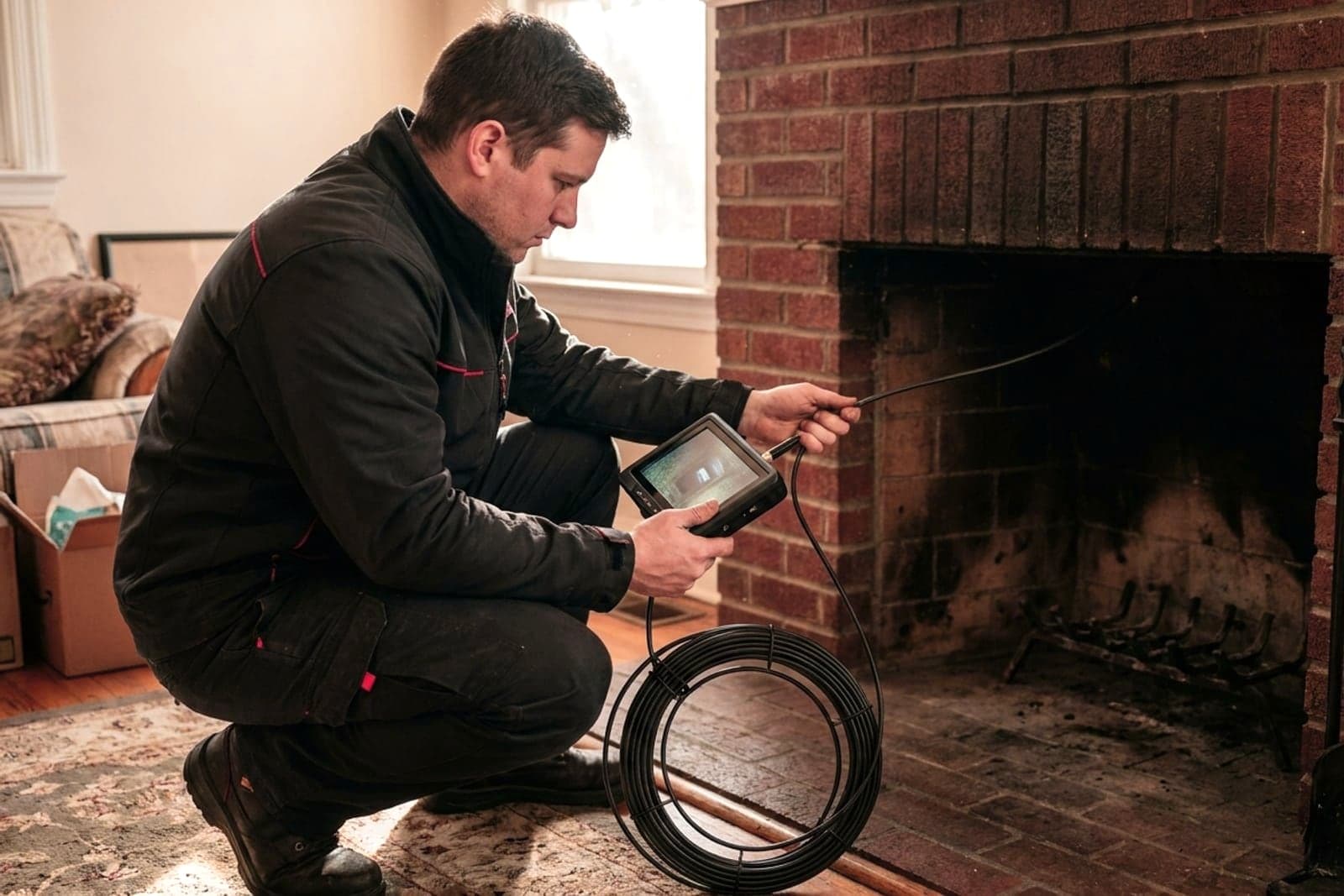
For most Tacoma homeowners with pre-1950 masonry chimneys, a Level 1 chimney inspection every two years that explicitly includes a close-up exterior mortar assessment is the most cost-effective early warning system available. An inspection in the $150 to $250 range that identifies a $700 tuckpointing job before it becomes a $2,500 partial rebuild is one of the clearest returns on investment in home maintenance.
Frequently asked questions
How long does tuckpointing last on a Tacoma chimney?
Correctly done tuckpointing on a Tacoma chimney, using a mortar mix matched to the original, typically lasts 20 to 30 years in Pierce County conditions. Using hard Portland cement mortar on older soft-brick chimneys shortens that to 5 to 10 years at best, because the brick faces crack and spall under the stress — which is why mortar matching is not optional on pre-1940 Tacoma homes.
Can I tuckpoint my chimney myself?
The mechanics of tuckpointing are learnable, but two factors make DIY particularly risky on Tacoma chimneys: safe access on the steep-pitched rooflines common to North End and Proctor Craftsmans, and mortar mix compatibility. Applying the wrong mortar to 100-year-old Tacoma brick causes accelerated spalling — faster damage than leaving the joints alone. For anything above single-story height, professional chimney masonry work is the right call.
Does homeowners insurance cover chimney masonry repair?
Standard homeowners insurance policies treat mortar deterioration on a Tacoma chimney as gradual wear and maintenance neglect, which is explicitly excluded from coverage. An exception may apply if a specific sudden event — a documented windstorm or a Nisqually-style seismic event — caused identifiable structural damage. Document the chimney's condition with photographs before filing any claim and review your policy's exclusions carefully.
What is the difference between efflorescence and mortar damage?
Efflorescence is white mineral salt staining on the brick face of a Tacoma chimney, caused by water moving through the masonry and depositing salts as it evaporates on the surface. Efflorescence signals active moisture infiltration but does not by itself mean the brick is structurally compromised. Mortar damage means the joints are eroded or missing material. Both conditions can exist simultaneously and both warrant a professional look — efflorescence is often the first visible indicator that mortar damage is progressing beneath the surface.
When is the best time of year to schedule masonry repair in Tacoma?
May through September is the reliable window for chimney masonry repair in Tacoma. Mortar requires consistent temperatures above 40 degrees Fahrenheit to cure properly, and Tacoma's shoulder seasons can drop below that threshold unpredictably. Get the inspection and quote done in fall if you spot deterioration; schedule the actual repair work for spring to ensure proper curing and avoid paying for a repair that fails before the next Pierce County winter.
Related services