
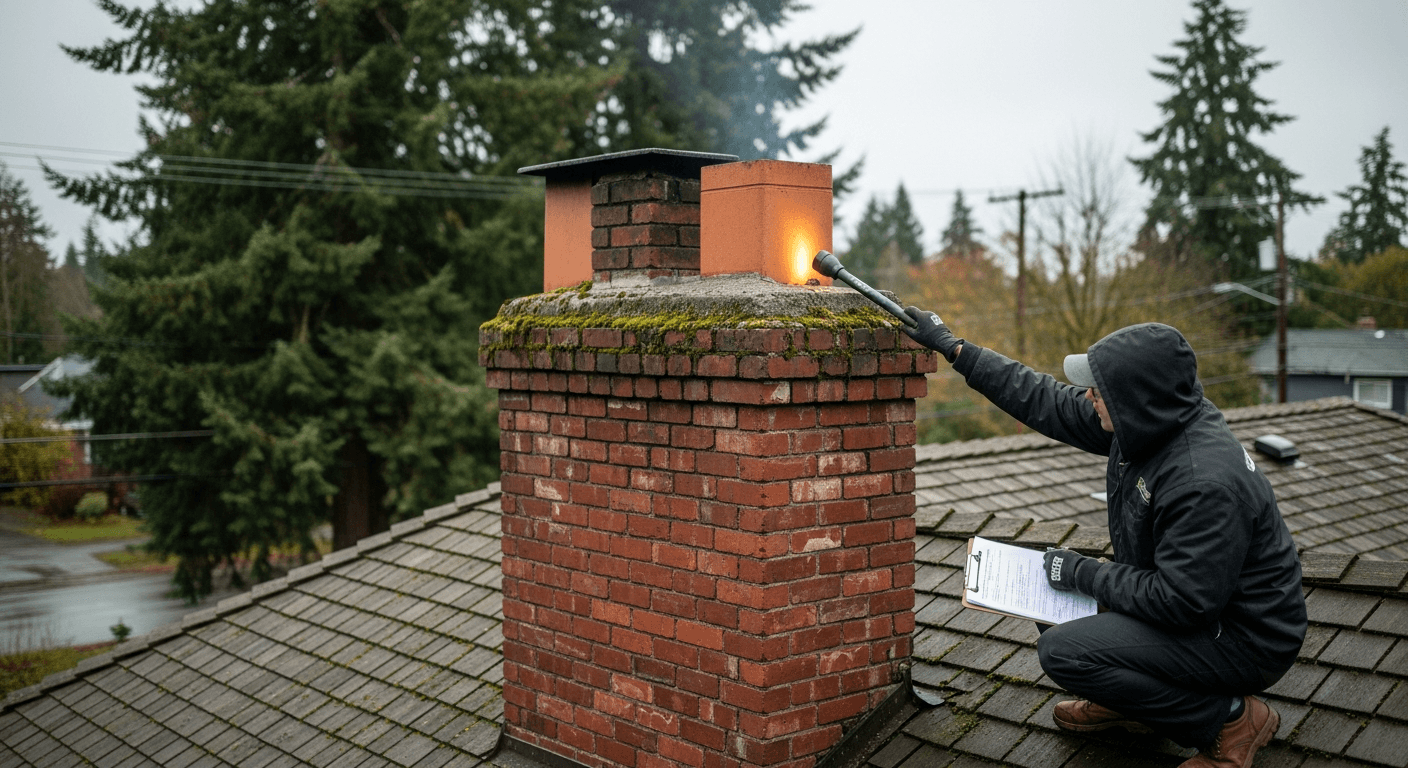
Your wood-burning fireplace is safe to use this winter if it passed a Level 1 inspection within the last 12 months, the flue is clear of obstructions, and you burned seasoned hardwood last season — but most Tacoma homes we visit haven't had all three boxes checked in years. Tacoma's 38 inches of annual rainfall, salt-laden air near the Thea Foss Waterway, and the city's dense stock of pre-1950 Craftsman and Tudor Revival masonry chimneys with original clay-tile liners mean a fireplace that looked fine last March can quietly develop an offset tile joint, a nesting-season bird blockage, or a deteriorated smoke chamber by the time October arrives. This guide tells you exactly what to verify before your first fire, what repairs cost from a Tacoma chimney professional in 2024–2025, and which warning signs mean you should step away from the match entirely.
The five things you must check before your first fire of the season
Start at the firebox. Open the damper fully and shine a flashlight straight up the flue. You should see a clean column of daylight at the top. A dark mass, audible rustling, or a damper plate that won't open fully or seal completely when closed means you have an obstruction, a wildlife intrusion, or a warped damper — all of which we find routinely in Tacoma homes that sat unused from April through September. Starlings and chimney swifts are the most frequent nesters in the North End and Proctor District chimneys we service.
Next, run a gloved finger along the inside walls of the firebox. Hairline cracks in refractory panels or mortar joints are normal thermal wear. Gaps wider than a quarter inch, any section of brick face that crumbles under light pressure, or mortar that pulls away in chunks are not normal. In the original clay-tile-lined masonry fireplaces that dominate Tacoma's Stadium District, North End, and Old Town neighborhoods, decades of thermal cycling cause tile sections to shift laterally, opening gaps that route carbon monoxide directly into wall cavities.
Check the chimney crown from ground level with binoculars. Look for white efflorescence streaks — a reliable sign of active water infiltration — cracks running across the crown surface, or missing mortar between exposed flue tiles above the roofline. Tacoma's freeze-thaw cycles from November through March erode crown mortar significantly faster than in the drier eastern Washington climate, and a compromised crown accelerates interior liner damage every wet season it goes unrepaired.
Test every smoke detector and carbon monoxide detector on the floor nearest the fireplace. Replace batteries if they haven't been swapped since last heating season. The NFPA recommends CO detectors within 15 feet of every sleeping room — advice that carries extra weight in a Tacoma home where the flue liner's integrity is unknown or hasn't been camera-inspected.
Confirm your firewood is genuinely seasoned. Split hardwood — alder, oak, and maple are the most available in the South Sound region — needs a minimum of six to twelve months of covered, off-ground drying to reach 20 percent moisture content or below. Wood above that threshold burns cooler, produces dramatically more creosote per cord, and is the single most common cause of the dangerous third-degree glazed creosote we find coating flues in Tacoma homes inspected every September and October.
What first-burn readiness actually costs in Tacoma — a realistic price breakdown
Most Tacoma homeowners need two things before safely lighting their first fire: a full chimney sweep and a Level 1 inspection. Certified professionals in Tacoma perform both in a single visit, which costs less than scheduling them separately and gives you one written report covering cleaning findings and visible structural conditions.
Prices at the lower end of each range reflect straightforward jobs — an accessible single-flue chimney, light-to-moderate creosote buildup, no structural complications. Prices toward the upper end reflect heavier deposits, taller or steeper rooflines common in Tacoma's hillside neighborhoods, or additional diagnostic steps. Any quote significantly below the sweep-plus-inspection range listed here should prompt you to ask precisely what is and is not included before booking.
When a Level 1 inspection flags a concern — suspected liner damage following an unusually hot burn, a home purchase, or a visible offset tile — the next step is a Level 2 inspection with continuous video camera imaging. That adds cost but produces timestamped photographic documentation and precise repair scoping, which matters greatly when you're deciding between a full stainless reline and a gas insert conversion in a 90-year-old masonry system.
| Service | Typical Tacoma Price Range | What's Included | When You Need It |
|---|---|---|---|
| Chimney sweep (Level 1 included) | $149 – $249 | Full rod-and-brush creosote removal, visual inspection of all accessible components, written report with photos | Annually — ideally September or October before the first fall fire |
| Level 2 inspection (camera) | $250 – $450 | Continuous video scan of full flue interior, timestamped still captures, detailed written repair recommendations | After any chimney fire, before a home purchase closes, or whenever Level 1 flags liner concerns |
| Firebox refractory panel replacement | $300 – $700 per panel | Remove damaged panel, install UL-listed refractory replacement, remortar joints | Cracks wider than 1/4 inch or any panel section that crumbles under light pressure |
| Clay-tile liner relining (stainless steel) | $2,000 – $5,500 | Install continuous stainless steel liner inside existing chase, new connector and top plate, swept clean before and after | Cracked, offset, or spalled clay tile sections; standard in Tacoma homes built before 1960 |
| Smoke chamber parging | $300 – $600 | Apply refractory mortar coat to corbelled smoke chamber walls above the damper shelf | Spalling brick, visible gaps, or rough corbelling that traps creosote above the damper |
| Damper replacement (top-mount) | $250 – $450 installed | Remove failed throat damper, install locking top-mount damper with silicone gasket to exclude rain and wildlife | Warped, rusted, or stuck damper plate that won't fully open or seal |
How Tacoma chimney symptoms map to their most common causes
Not every fireplace problem announces itself with a dramatic event. In Tacoma's older masonry chimneys, the most dangerous conditions — offset liner joints, third-degree creosote, and active water infiltration — often develop silently between seasons. The table below maps the observable symptoms a Tacoma homeowner is most likely to notice to the underlying causes those symptoms indicate, and flags the inspection level required to confirm each one. Use it as a triage guide: if you recognize a symptom on the left, the corresponding cause column tells you what your chimney professional will be investigating, and the rightmost column tells you what documentation you need before relighting.
This symptom-to-cause mapping is not a substitute for a professional inspection — several causes share symptoms, and more than one cause can be present simultaneously. It is intended to help Tacoma homeowners arrive at their service appointment with a clear picture of what they observed, so the technician can prioritize the camera or visual examination accordingly.
| Symptom You Can Observe | Most Likely Cause in Tacoma Masonry Chimneys | Secondary Cause to Rule Out | Inspection Level Required to Confirm |
|---|---|---|---|
| Smoke backing into the room during a fire | Blocked or partially obstructed flue (bird nest, debris) | Failed or warped damper; negative air pressure from tight renovation | Level 1 — flashlight and damper check; Level 2 if obstruction isn't visible |
| Dark, shiny, hard coating inside the firebox opening | Third-degree glazed creosote from burning unseasoned wood | Accumulated second-degree creosote from infrequent burning | Level 1 — visual identification; chemical pre-treatment required before sweep |
| Smoke or burning smell from walls or ceilings when fireplace is not in use | Liner breach allowing combustion gases into wall cavities | Failed smoke chamber mortar with gap to adjacent framing cavity | Level 2 camera inspection — breach location cannot be identified visually from firebox |
| White efflorescence streaks on exterior chimney face | Active water infiltration through crown or deteriorated mortar joints | Condensation from flue gas interacting with cold clay tile | Level 1 from roofline; Level 2 if interior liner saturation is suspected |
| Damper plate stuck, warped, or won't seal fully | Rust or thermal distortion of throat damper from moisture cycling | Impact damage from fallen debris inside the flue | Level 1 — damper operation check; replacement quoted on same visit in most Tacoma cases |
| Audible rustling or visible dark mass when flashlight aimed up flue | Active bird nesting (starlings, chimney swifts common in Tacoma) | Debris accumulation from deteriorated clay tile sections falling in | Level 1 — flashlight inspection; wildlife removal required before any sweep proceeds |
| Mortar crumbling or brick face friable at roofline | Freeze-thaw erosion of crown mortar through Tacoma's November–March wet season | Salt-air deterioration accelerating spalling near waterfront neighborhoods | Level 1 from roofline with binoculars; repointing or crown rebuild scoped on same visit |
A hypothetical Tacoma scenario: when a 'working fireplace' turned out to be a liability
Consider a common situation our technicians encounter each fall: a homeowner purchases a 1928 Craftsman bungalow in Tacoma's North End. The sellers disclosed the fireplace as 'working and recently used.' The general home inspector's report noted no major concerns. The new owner wants a fire the first cool weekend of October and schedules what they expect to be a routine pre-season sweep.
When the technician opens the damper and performs the initial flashlight check, one section of the original clay flue tile has shifted laterally — an offset joint leaving roughly a half-inch gap exposed to the surrounding masonry chase. Heavy second-degree creosote coats the upper firebox through the lower third of the flue, a clear sign the previous owners had been burning unseasoned wood. The firebox is placed out of service before any further work continues.
A Level 2 camera inspection documents three offset tile joints and one tile with a longitudinal crack running nearly its full length. The homeowner has two repair paths: a full stainless steel reline to bypass all damaged clay sections, or decommissioning the fireplace and installing a gas insert. In this scenario, the homeowner chooses a 6-inch stainless liner with a new top plate and has the smoke chamber parged at the same time to address the rough corbelling above the damper shelf. At the price ranges listed in this article, a repair of that scope would typically fall in the range of $2,300 to $6,100 depending on flue height and access. The first fire in such a fireplace could happen six weeks after the initial appointment.
This type of scenario repeats itself throughout Tacoma's older neighborhoods every fall. Original clay-tile liners were engineered for a 50-year service life under consistent, correctly fueled use. Many Tacoma systems are now 80 to 100 years old, have cycled through multiple owners with varying fuel and burning habits, and have never been camera-inspected. A general home inspector carries no specialized training or tooling to evaluate flue liner integrity. If your Tacoma home was built before 1960 and has not had a Level 2 camera inspection, scheduling one before this heating season is the highest-value safety step available to you.
Warning signs that mean stop — do not light the fireplace until this is fixed
Certain findings place a fireplace out of service immediately. These are not 'monitor it and see' situations. Each one below requires a professional assessment and written clearance before any fire is lit.
Smoke backing into the room during or after a fire is the call we receive most often from Tacoma homeowners in October and November. The cause can be a blocked flue, a failed damper, negative air pressure in a well-sealed modern renovation, or a damaged smoke chamber — and in every one of those scenarios, carbon monoxide is entering the living space alongside the visible smoke. Opening a window is not a fix. Stop using the fireplace and schedule an inspection.
A dark, shiny, or tar-like coating visible inside the firebox opening — particularly one that feels hard when tapped — is third-degree glazed creosote. Standard rod-and-brush sweeping cannot remove it. It requires chemical pre-treatment followed by specialized mechanical removal. Until that work is completed by a certified professional, the fireplace presents an active chimney fire risk.
Any odor of smoke or burning coming from walls, ceilings, or adjacent rooms when the fireplace is not in use indicates a liner breach. Combustion gases are reaching the framing. This is a simultaneous fire and carbon monoxide hazard that requires same-week professional attention, not a spring service appointment.
White efflorescence streaking down the exterior chimney face, soft or friable brick at the roofline, or visible gaps around the flue tile above the chimney cap all indicate that water has been working inside the masonry assembly. In Tacoma's climate, a slow infiltration point that goes unrepaired through one wet season can accelerate into a structurally compromised liner by the following October. Water damage at the liner level is not visible from inside the firebox — it requires a camera to find and a professional to quantify.
How to find a trustworthy chimney professional in Tacoma
The minimum credential to require is CSIA certification — the Chimney Safety Institute of America. A CSIA Certified Chimney Sweep has passed a proctored written exam covering NFPA fire codes, chimney system components, and current safety practices, and must complete continuing education to maintain the credential. It does not guarantee perfection, but it establishes a documented baseline of technical knowledge that unlicensed operators cannot demonstrate.
Ask directly whether the sweep carries general liability insurance and workers' compensation coverage. A technician working on a wet Tacoma roofline in October without those coverages creates direct financial exposure for you as the homeowner if anything goes wrong. Any legitimate professional provides proof of insurance without hesitation or qualification.
Require a written quote before any work begins. That quote should specify: rod-and-brush cleaning of the full measurable flue length, debris removal from the firebox, a written Level 1 inspection report, and photos of any conditions noted. Verbal estimates with no written scope are a consistent indicator of a problematic service experience.
Be wary of dramatically low sweep prices used as a door-opener followed by high-pressure repair recommendations based on photos you cannot independently verify. A trustworthy Tacoma chimney professional shows you the camera footage or photos, explains exactly what was found and why it matters, provides repair options in writing with itemized pricing, and gives you time to decide. Urgency tactics and unverifiable damage claims are the two clearest signals to end the appointment.
Frequently asked questions
How often does a wood-burning chimney in Tacoma actually need to be cleaned?
NFPA 211 requires annual inspection and cleaning as needed. For Tacoma homeowners burning wood regularly through a full heating season — typically October through March — that means one sweep per year, ideally in September before the first fire. If you burn fewer than two cords per season or use the fireplace only occasionally, you still need the annual inspection, because moisture infiltration and wildlife nesting damage accumulate in Tacoma chimneys regardless of how often you burn.
What should a chimney sweep cost in Tacoma?
A full chimney sweep with a Level 1 inspection included runs $149 to $249 from a CSIA-certified professional in Tacoma. Quotes below that range — particularly anything advertised under $99 — typically indicate an incomplete service or a business model built on upselling repairs once the technician is inside your home. Always ask for a written scope of work before booking.
Is a chimney inspection worth scheduling if the fireplace seems to be working fine?
Yes — particularly in Tacoma. The most serious hazards in older masonry chimneys, including offset clay tile joints, longitudinal liner cracks, and second- or third-degree creosote buildup, produce no symptoms visible from inside the firebox. They are found with a flashlight and camera, not by watching smoke behavior. In a Tacoma home with an original pre-1960 clay-tile liner, a Level 2 camera inspection can identify conditions that would cause a chimney fire or CO intrusion within the same heating season.
When do I actually need a Level 2 chimney inspection versus a standard sweep?
A Level 2 inspection with continuous video camera imaging — priced at $250 to $450 in Tacoma — is indicated in four situations: you have just purchased a home with a fireplace; a Level 1 inspection flagged a concern; you experienced an unusually hot burn or visible chimney fire puff; or your Tacoma home was built before 1960 and has never had a camera inspection. It is not required annually for a well-maintained, regularly swept system with no flagged concerns.
Does skipping the annual inspection affect my homeowners insurance if I have a chimney fire?
It can. Most homeowners insurance policies require that wood-burning appliances be maintained in accordance with manufacturer guidelines and applicable fire codes — both of which reference annual inspection. A documented inspection gap gives an insurer grounds to deny or reduce a chimney fire claim for a Tacoma home. Beyond the insurance issue, the physical risk to the home and its occupants is the more immediate reason not to skip the annual chimney inspection.
Related services


